Most people have burned at least one batch of bacon in their life. You step away for thirty seconds, and suddenly those beautiful strips go from golden to charcoal. Or worse — you pull them off too early, and they’re floppy, pale, and kinda chewy in all the wrong ways.
The truth? Knowing how to tell when bacon is done isn’t about setting a timer and hoping for the best. It’s about reading the cues — color, texture, sound, and even the way the fat behaves in the pan. And once you understand these cues, you’ll nail it every single time, whether you like your bacon soft and bendy or snappy and crisp.
Let’s break it all down.
Why Getting Bacon Doneness Right Actually Matters
You might think it’s just bacon — how hard can it be? But there’s more going on than meets the eye.
Undercooked bacon carries a real risk. Pork products, including bacon, can harbor bacteria like Salmonella and parasites like Trichinella spiralis if they don’t reach a safe internal temperature. The USDA recommends cooking pork to 145°F (63°C), and since bacon is sliced thin, it usually hits that mark pretty quickly. But “pretty quickly” doesn’t mean “instantly.” Pulling bacon off heat too early — especially thick-cut varieties — can leave you with meat that hasn’t been fully rendered or properly cooked through.
On the flip side, overcooked bacon isn’t just disappointing to eat. When bacon burns and chars beyond a dark brown into blackened territory, it can develop compounds like polycyclic aromatic hydrocarbons (PAHs) and heterocyclic amines (HCAs), both of which are linked to health concerns according to the National Cancer Institute. So there’s a genuine sweet spot you’re aiming for — and it’s not just about taste.
Beyond food safety, texture and flavor are at stake. Perfectly done bacon has a balance between the rendered fat and the meat. The fat should be translucent or lightly golden — not white and rubbery, and not dark brown and bitter. The meat should have deepened in color from raw pink to a warm reddish-brown. That balance is what makes bacon so addictive.
The Visual Signs — What Done Bacon Actually Looks Like
Your eyes are your best tool here. Forget timers for a second and just look at the bacon.
Color is the first indicator. Raw bacon is pale pink with white fat streaks. As it cooks, the meat darkens from pink to a reddish-brown, and the fat turns from opaque white to translucent, then to a light golden color. When both the meat and the fat have changed color — meat is a deep reddish-brown and fat is golden — you’re in the “done” zone.
Here’s the tricky part: bacon will continue to darken slightly after you remove it from heat. Those residual oils are still hot and still cooking the surface. So if you wait until it looks perfect in the pan, it’ll actually be a touch overdone on your plate. Pull it when it’s about 90% of the way to your ideal color.
What about different doneness levels? Not everyone wants the same bacon.
If you like chewy, soft bacon, look for meat that’s turned brown but fat that’s still slightly translucent and pliable. The strip should bend easily without breaking. Some white patches of not-fully-rendered fat are okay at this stage — they’ll give you that meaty chew.
For classic crispy bacon — the kind most restaurants serve — the fat should be fully golden, the meat a deep brown, and the strip should hold its shape when you lift it with tongs. It’ll still have a tiny bit of flex but feel firm.
And if you’re in the extra-crispy camp, you want the fat to be deeply golden (but not dark brown) and the strip should snap if you try to bend it. Be careful here because the line between extra-crispy and burned is razor-thin — we’re talking 30 seconds at most.
⚠️ Warning: If you see any areas of the meat that are still pink or the fat is still completely white and jiggly, it’s not done yet. Give it more time.
Listen to Your Bacon — The Sound Test
This might sound strange, but experienced cooks don’t just watch their bacon — they listen to it.
When bacon first hits a hot pan, you hear an aggressive, loud sizzle. That’s moisture escaping from the surface. The water content in bacon (it’s about 40% water in its raw state) is rapidly evaporating, and that violent bubbling is the proof.
As the bacon cooks and moisture reduces, the sound changes. The aggressive sputtering calms down into a steadier, gentler sizzle. The fat is now rendering — meaning the solid fat is melting and turning into liquid. This is the rendering phase, and it’s where the magic happens.
When you notice the sizzling become quieter and more consistent — almost a gentle hiss rather than an angry crackle — that’s your cue to start paying close attention. Your bacon is approaching done. The moisture is mostly gone, the fat has rendered, and now you’re just crisping things up.
If the sound suddenly gets louder again or you hear sharp popping, that usually means the fat is getting very hot and possibly starting to smoke. Time to pull that bacon off immediately or reduce your heat.
🔥 Pro Tip: If you’re cooking bacon frequently, train yourself to listen. After a few batches, you’ll instinctively know where things stand based on sound alone — even with your back turned.
The Touch and Texture Test
If you’re comfortable getting close to the pan (carefully, with tongs — never fingers), the texture of the bacon tells you a lot.
Use tongs to lift a strip from the center. How does it behave?
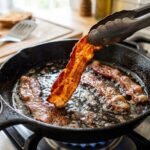
A done strip will hold its shape for a moment before slowly drooping at the ends — like a little bridge that’s just starting to sag. It should feel firm to the touch but not rigid. If you press it gently between your tongs, there should be slight resistance, not mushiness.
An underdone strip will droop immediately, folding in half like a wet towel. It’ll feel soft and floppy, and the surface will look wet or greasy with unrendered fat.
An overdone strip will be completely stiff when lifted. No flex at all. If it feels like a thin cracker, you’ve gone too far. It’s still edible, but you’ve lost that beautiful fat flavor and you’re mostly eating crunch.
One thing people often overlook: bacon texture varies by cut thickness. Regular-cut bacon (about 1/16 inch) crisps up faster and gives less room for error. Thick-cut bacon (around 1/8 inch) takes longer but offers a wider window for your ideal doneness because there’s more meat to work with. Center-cut bacon has less fat and tends to crisp more evenly but also dries out faster.
Does Cooking Method Change How You Check Doneness?
Absolutely. The method you use affects how bacon cooks, how long it takes, and what cues to prioritize. Let’s walk through the most common methods.
Pan-Frying on the Stovetop
This is the classic method, and it gives you the most control. You can see the bacon, hear it, and adjust heat in real time.
Start with a cold pan. Seriously — don’t preheat. Laying bacon in a cold pan and bringing the heat up gradually allows the fat to render slowly and evenly. If you drop bacon into a screaming hot pan, the outside will crisp before the fat renders, and you’ll get chewy, greasy strips with burnt edges.
Keep the heat at medium to medium-low. If you’re not sure what temperature that means on your stove, a guide to simmer temperatures can help you calibrate your burners.
Flip the strips every 2–3 minutes for even cooking. Total time for regular-cut bacon on the stove is usually 8–12 minutes. Thick-cut can take 12–18 minutes.
Your primary cues here are color, sound, and the tong test described above.
Oven-Baked Bacon
Baking bacon on a sheet pan at 400°F (204°C) is the hands-off method that’s become hugely popular — and for good reason. It cooks evenly, renders fat beautifully, and lets you handle large batches.
The catch? You can’t hear the sizzle as well through an oven door, so you rely more on visual checks. Start checking around the 12-minute mark for regular-cut. Thick-cut might need 18–22 minutes.
Open the oven and look: the fat should be bubbling gently and turning golden. The meat should be a deep reddish-brown. If you’re using parchment paper on your sheet pan (and you should — check out the differences between butcher and parchment paper if you’re unsure which to use), the bacon will release easily when done and stick slightly when underdone.
🔥 Pro Tip: Oven-baked bacon goes from done to overdone very fast in the last 2–3 minutes. Set a timer and check frequently toward the end. Carry-over cooking is real here — pull it slightly before your ideal and let it rest on a paper towel-lined plate.
Microwave
Microwaving bacon works in a pinch. Layer strips between paper towels on a microwave-safe plate. Cook on high for about 1 minute per slice as a starting point, but microwaves vary wildly in power.
Visual cues are your main check. The bacon should look brown and the paper towels should have absorbed visible grease. Since bacon in a microwave doesn’t get the same even heat distribution, you might notice some spots are crispier than others. That’s normal.
Microwaved bacon tends to crisp up more as it cools, so pull it when it still looks slightly underdone compared to your target.
Grilling and Smoking
Cooking bacon on a grill — especially over indirect heat or in a smoker — adds another flavor dimension. But the higher heat from direct flame means you need to watch it like a hawk.
On a grill, bacon can go from raw to charred in under 5 minutes over direct heat. Use medium-low heat, keep the lid open, and flip frequently. The same color and texture cues apply, but grease flare-ups can char spots quickly, so stay attentive.
If you’re interested in smoking meats and getting temperatures right, understanding tools like a meat thermometer is always a good idea, even if you won’t typically probe individual bacon strips.
Can You Use a Meat Thermometer for Bacon?
Technically, yes — but practically, it’s tough. Bacon strips are thin, and getting an accurate read from a standard instant-read thermometer on a 1/16-inch piece of meat is nearly impossible. The probe is thicker than the bacon itself.
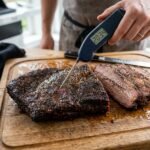
That said, if you’re cooking thick-cut bacon or a bacon slab (like pork belly that hasn’t been sliced), a thermometer becomes genuinely useful. You’re aiming for an internal temperature of 145°F (63°C) — the USDA’s safe minimum for pork. A good meat thermometer inserted sideways into the thickest part of a slab will give you a reliable reading.
For regular sliced bacon, trust your senses: color, sound, texture, and the visual appearance of rendered fat. Those cues are more practical and just as reliable for thin cuts.
Thick-Cut vs. Thin-Cut — Different Rules Apply
Not all bacon cooks the same way, and thickness is the biggest variable.
Thin-cut bacon (sometimes labeled “restaurant style”) cooks fast. You’re looking at 6–8 minutes in a pan, and the margin for error is small. It goes from chewy to crispy to burned in a very short window. With thin bacon, pull it off the heat the moment you see uniform golden-brown color. Carry-over cooking will finish the job.
Thick-cut bacon gives you more breathing room. It takes longer — 12–18 minutes on the stove — but the extra meat means the center stays juicy even when the exterior crisps up. You’ll notice that thick-cut bacon has a meatier chew even when fully cooked. The rendered fat will pool more in the pan because there’s simply more of it. That extra fat is liquid gold for cooking eggs afterward, by the way.
Center-cut bacon is trimmed from the leaner middle of the pork belly. It has less fat overall, which means faster crisping but also a higher risk of drying out. Keep your heat a touch lower with center-cut and check it earlier than you would regular bacon.
This is similar to how different cuts of meat behave differently during cooking — the same way a pork chop needs a specific internal temp and a pork sausage has its own doneness cues, bacon varies by its cut and thickness.
What Perfectly Done Bacon Looks Like on the Plate
There’s one more check after you pull bacon from the heat — what it looks like after resting for about 60 seconds.
Properly cooked bacon on a paper towel-lined plate should look uniformly golden-brown to deep brown. No pale, white, or pink areas. No dark spots that look charred or black. The surface should appear slightly glossy from rendered fat, but not dripping wet.
Pick up a strip. It should feel light — much lighter than it felt raw. That’s because it’s lost most of its water content and a good portion of its fat has rendered out. If it still feels heavy and limp, it needed more time.
Tap it gently against the plate. Done bacon makes a quiet, satisfying “tik” sound — like tapping a thin chip. Underdone bacon makes a soft, muted “thud.” Overdone bacon might shatter.
Did you know? Bacon loses about 40–50% of its weight during cooking. A pound of raw bacon yields roughly 8–10 ounces of cooked bacon. So if you’re cooking for a crowd, account for that shrinkage.
Common Mistakes That Mess Up Bacon Doneness
A few habits consistently lead to bacon that’s either underdone or overdone. Here’s what to avoid.
Cranking the heat too high is the number one mistake. High heat crisps the outside before the inside is cooked through and the fat renders. You end up with a strip that looks done on the surface but has chewy, rubbery fat in the center. Low and slow wins with bacon. Always.
Overcrowding the pan is another classic error. When strips overlap, they steam instead of fry. The overlapping areas stay pale and limp while the exposed edges burn. Give your bacon space — each strip should lay flat without touching its neighbors. If you’re cooking a big batch, work in rounds or use the oven method.
Not flipping can cause uneven cooking. Some people swear by the “set it and forget it” approach, but unless you’re baking in the oven, flipping every few minutes ensures both sides get equal heat exposure.
Judging doneness too early is surprisingly common. People see the color changing and panic, pulling the bacon off before the fat has fully rendered. Give it time. The fat needs to go from white and opaque to golden and translucent. If you pull it when the fat is still partly white, those sections will be chewy and waxy — not in a good way.
Storing and Reheating Done Bacon
Let’s say you’ve nailed the doneness. You’ve got beautiful, perfectly cooked strips. What if you made too much?
Cooked bacon stores well in the fridge for 4–5 days in an airtight container or zip-lock bag with paper towels to absorb excess grease. Knowing how long cooked meat lasts in the fridge is useful across the board — similar to how cooked steak has its own fridge life.
To reheat, a quick 15–20 seconds in the microwave brings it back to life. Or lay it on a baking sheet and pop it in a 350°F oven for 5 minutes. The oven method re-crisps it better than the microwave.
You can also freeze cooked bacon for up to 3 months. Lay strips flat on parchment paper, stack them in a freezer bag, and thaw in the fridge overnight when you need them.
🔥 Pro Tip: Slightly undercook bacon that you plan to reheat later. It’ll crisp up during reheating and end up at your perfect doneness level.
A Quick Doneness Reference by Cooking Method
Here’s a practical summary to keep handy:
Stovetop (medium-low heat): Regular-cut 8–12 min, thick-cut 12–18 min. Watch for golden fat and deep brown meat. Flip every 2–3 minutes.
Oven at 400°F: Regular-cut 12–16 min, thick-cut 18–22 min. Check frequently after the 12-minute mark. Pull slightly early for carry-over cooking.
Microwave: Roughly 1 minute per slice on high. Paper towels above and below. Expect uneven results. Let it cool before judging — it firms up as it cools.
Grill (medium-low, indirect heat): 5–8 minutes total. Flip frequently. Watch for flare-ups from dripping fat.
FAQ
How do I know if bacon is undercooked?
Undercooked bacon has visible areas of pink meat and white, rubbery fat that hasn’t rendered. It feels floppy and limp when lifted with tongs, and the surface looks wet or greasy. The USDA recommends cooking pork to an internal temperature of 145°F to ensure safety, so if your bacon still looks raw in spots, keep cooking.
Is slightly chewy bacon safe to eat?
Yes — chewy bacon is safe as long as the meat has changed from raw pink to brown and the fat has begun to render (turn translucent). Some people genuinely prefer their bacon on the softer, chewier side. The key safety indicator is color: no raw pink meat should remain. If the meat is brown but the fat is still slightly soft, that’s a preference thing, not a safety issue.
Can bacon look done but still be unsafe?
It’s rare with standard sliced bacon because the strips are so thin that visual doneness and safe temperature are reached almost simultaneously. But with very thick slabs or pork belly, yes — the surface could brown while the interior hasn’t reached 145°F. For thick cuts, an instant-read thermometer inserted sideways into the meat is your best bet for confirmation.
Does bacon get crispier as it cools?
Yes, absolutely. Bacon continues to firm up and crisp for about 1–2 minutes after you remove it from heat. The residual fat cools and solidifies, tightening the texture. This is why pulling bacon off the heat when it’s almost at your ideal crispness — rather than exactly at it — gives you better results on the plate.
What’s the best heat level for cooking bacon?
Medium to medium-low heat is ideal for most cooking methods. This allows the fat to render slowly and evenly without burning the meat. High heat cooks the surface too fast, trapping unrendered fat inside and creating strips that are burnt on the outside and chewy on the inside.
Your Bacon, Your Call
At the end of the day — and I mean this literally for your breakfast — telling when bacon is done comes down to reading a few simple signals. Golden fat, deep brown meat, a calming sizzle, and firm-but-flexible texture. That’s the formula.
There’s no single “correct” bacon doneness. Some people live for that shatteringly crispy strip, and others want it soft enough to fold into a sandwich. Both are valid. What matters is that you can consistently hit your preferred level every time you cook.
Start paying attention to those visual and audio cues. After just two or three batches of intentional practice, you won’t need a timer, a thermometer, or a recipe. You’ll just know. And that’s a kitchen skill worth having.