You just pulled a turkey burger off the grill. It looks done on the outside — nice browning, firm to the touch. You cut it open, and… it’s slightly pink. Now you’re standing there, spatula in hand, wondering: Is this safe to eat or am I about to ruin everyone’s weekend?
That moment of doubt? It happens to almost everyone who cooks turkey burgers. And here’s the real problem — guessing your way through ground turkey doneness is a gamble you don’t want to take. Unlike a beef burger where a little pink might be fine, turkey plays by different rules. The internal temperature of a turkey burger needs to hit one very specific number before it’s safe to eat.
Let’s break it all down — no fluff, no confusion, just what you actually need to know.
Why Turkey Burgers Need a Different Approach Than Beef
If you’ve been cooking beef burgers for years, you probably have a feel for when they’re done. Medium, medium-well — you might even eyeball it. But that instinct can actually work against you with turkey burgers.
Here’s why: ground turkey is poultry. And poultry carries a higher risk of harboring harmful bacteria like Salmonella and Campylobacter compared to beef. These bacteria don’t just live on the surface of the meat — they get mixed throughout during grinding. So while a beef steak might be safe with a quick sear (bacteria is mainly on the outside), ground turkey needs to be cooked all the way through.
The other tricky part? Turkey burger color isn’t reliable. A turkey burger can look perfectly white inside and still be undercooked. Or it can have a slight pink tinge and be completely safe. Color lies. Temperature doesn’t.
That’s exactly why the USDA doesn’t give you a range for poultry — they give you a hard line.
The Magic Number: 165°F (74°C)
According to the USDA Food Safety and Inspection Service, all ground poultry — including turkey — must reach an internal temperature of 165°F (74°C) to be considered safe. At this temperature, harmful bacteria are destroyed instantly.
Not 155°F. Not 160°F. 165°F.
This isn’t a suggestion or a “nice to have.” This is the food safety standard followed by restaurants, commercial kitchens, and recommended for home cooks across the United States.
⚠️ Quick Fact: The 165°F rule applies to all ground poultry products — turkey burgers, chicken burgers, turkey meatloaf, chicken sausage patties. If it’s ground and it’s poultry, that number doesn’t change. If you’re curious how this compares to other ground meats, check out this guide on hamburger internal temperature to see the differences.
How to Check the Temperature the Right Way
Owning a meat thermometer is only half the battle. You’ve got to use it correctly, or you’ll get a reading that’s either too high or too low — both of which cause problems.
Step 1: Use an instant-read thermometer. Digital instant-read thermometers give you an accurate reading in about 2–3 seconds. They’re cheap (most good ones cost under $15), and they take all the guesswork out. Dial thermometers work too, but they’re slower and less precise. If you’re unsure how to use one properly, this detailed walkthrough on how to read a meat thermometer is really helpful.
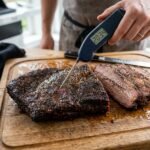
Step 2: Insert the probe into the thickest part of the patty. Push it in from the side, horizontally, so the tip of the probe reaches the center. Don’t poke through the bottom and hit the grill grate or pan — that’ll give you a false reading.
Step 3: Wait for the number to stabilize. Even with an instant-read, give it a moment. The number might jump around for a second before settling. That settled number is your actual internal temp.
Step 4: Check more than one burger. If you’ve got four patties on the grill, don’t check just one and assume the rest are the same. Heat distribution isn’t always even, especially on charcoal grills or older gas grills. A quick poke into each patty takes five seconds and saves you from serving one underdone burger.
🔥 Pro Tip: Clean the thermometer probe with a sanitizing wipe between testing raw and cooked items. Cross-contamination is a real thing, and it takes literally three seconds to prevent.
Can You Pull a Turkey Burger Below 165°F and Let It Carry Over?
This is where things get interesting, and honestly, this is the question experienced cooks tend to ask the most.
Carryover cooking is real. When you pull any meat off heat, the internal temperature keeps climbing for a few minutes because the outer layers of the meat are hotter than the center, and that heat keeps transferring inward.
For thick cuts like brisket or a pork shoulder, carryover can add 5–10°F easily. But turkey burgers? They’re thin. Usually around ¾ inch to 1 inch thick. That means carryover cooking on a turkey burger patty is minimal — maybe 2–3°F at best.
So if you pull your turkey burger at 160°F expecting it to coast up to 165°F, you’re taking a risk. It might get there. It might not. And with ground poultry, “might” isn’t good enough.
The safe play: Pull your turkey burger when the thermometer reads 163–165°F. If it climbs a degree or two while resting, great — that just adds safety margin. But don’t pull at 155°F and hope for the best.
Now, there’s a more nuanced food science angle here. The USDA’s 165°F is based on instantaneous pasteurization — meaning all bacteria are killed the moment the meat hits that temp. But technically, bacteria can also be eliminated at lower temperatures if held there for longer. For example, the USDA’s own tables show that poultry held at 157°F for 51 seconds achieves the same log reduction in Salmonella. Some sous vide cooks use this approach.
But here’s my honest advice: unless you’re doing precision sous vide cooking with calibrated equipment and you truly understand time-temperature pasteurization charts, stick with 165°F. It’s simple, it’s safe, and it works every single time.
What Happens If You Undercook a Turkey Burger?
Let’s not sugarcoat this. Eating undercooked ground turkey can make you sick — sometimes very sick.
Salmonella is the big one. According to the CDC, Salmonella causes roughly 1.35 million infections in the U.S. every year, with poultry being one of the top sources. Symptoms typically show up 6 to 72 hours after eating contaminated food and include stomach cramps, diarrhea, fever, and nausea. Most healthy adults recover in a few days, but for young children, elderly people, pregnant women, and anyone with a weakened immune system, it can become serious enough to require hospitalization.
Campylobacter is another bacteria commonly found in raw poultry. Symptoms are similar — diarrhea (sometimes bloody), cramping, and fever — and it’s actually the most common bacterial cause of food poisoning in the United States.
An undercooked turkey burger might taste fine. It might even look fine. But the bacteria you can’t see or taste are the ones that cause trouble. This is exactly why temperature matters more than appearance.
Why Does My Turkey Burger Look Pink Even at 165°F?
This throws people off all the time. You check the temp, it reads 165°F or even 170°F, but when you cut the burger open, there’s a pinkish color inside. Your brain immediately says “not done.” But your thermometer says otherwise.
So what’s going on?
A few things can cause this. Myoglobin, the protein that gives meat its color, doesn’t always turn fully white/brown during cooking — especially in young turkeys. The pH level of the meat can also affect color changes. Turkey that’s slightly more acidic might retain a pink hue even when fully cooked.
Smoked turkey burgers can also develop a pink color from the smoking process itself. The smoke ring — that pink layer you see on smoked meats — happens because of a chemical reaction between nitrogen dioxide in the smoke and the myoglobin in the meat. It’s cosmetic, not a sign of rawness.
If your thermometer says 165°F and you inserted it correctly into the center, that burger is safe. Trust the number, not the color.
How to Cook a Juicy Turkey Burger That Hits 165°F Without Drying Out
Here’s the real challenge with turkey burgers, right? Turkey meat is naturally leaner than beef — especially ground turkey breast, which can be as low as 1–2% fat. That means it dries out fast. And if you’re aiming for 165°F, there’s very little room between “safe” and “hockey puck.”
But it’s absolutely possible to cook a turkey burger that’s safe AND still juicy. Here’s how.
Choose the right grind. If you’re buying packaged ground turkey, check the fat percentage. Ground turkey that includes both white and dark meat (usually labeled 85/15 or 93/7) has more fat and flavor than 99% lean ground turkey breast. That extra fat is what keeps the burger moist during cooking. Think of it like this — fat is your insurance against dryness.
Don’t overwork the meat. When forming patties, handle the meat as little as possible. The more you squeeze, press, and shape, the denser and tougher the burger becomes. Gentle shaping is the move.
Make a dimple in the center. Press your thumb into the center of each patty before cooking. Turkey burgers (like all burgers) tend to puff up in the middle as they cook, which pushes the center away from the heat source. The dimple counteracts that, so you get more even cooking — which means you don’t have to overcook the edges just to get the center done.
Add moisture from within. Mix in a tablespoon of olive oil, Worcestershire sauce, or even a little bit of finely diced onion into the ground turkey before forming patties. These additions add moisture that stays inside the burger as it cooks. Some people even add a small amount of mayonnaise into the mix — sounds weird, but it works.
Control your heat. High heat is the enemy of lean meats. Cook turkey burgers over medium heat — whether that’s on a grill, skillet, or griddle. This gives the center time to reach 165°F before the outside burns or dries out. On a grill, that’s roughly 375–400°F. On a stovetop, medium flame with a little oil in the pan. If you use a simmer temperature on the stove, that’s too low — you want medium, not low.
Don’t press the patty while cooking. I know it’s tempting. That sizzle sound when you press down is satisfying. But every time you smash a turkey burger with your spatula, you’re squeezing out juices — juices you desperately need to keep the burger moist. Flip it once, maybe twice. That’s it.
Rest the burger for 2–3 minutes after cooking. Just like with any other protein, a short rest lets the juices redistribute inside the patty instead of pouring out the moment you cut into it.
Cooking Times by Method — A Quick Reference
Exact cooking times depend on patty thickness, starting temperature of the meat, and how hot your cooking surface actually is. But here are general guidelines for a standard ¾-inch thick turkey burger patty:
Grill (gas or charcoal): About 5–6 minutes per side over medium heat (roughly 375–400°F grill surface temperature). Keep the lid closed between flips for more even cooking.
Stovetop skillet or griddle: 4–5 minutes per side over medium heat. Use a tablespoon of oil or cooking spray to prevent sticking — turkey burgers don’t have enough fat to self-lubricate the pan like a beef burger does.
Oven-baked: Place patties on a lined baking sheet at 375°F for about 20–25 minutes, flipping once halfway through. This method is great for cooking a large batch at once. It’s a little more forgiving than grilling because the heat is more consistent.
Air fryer: 375°F for about 8–10 minutes per side. Air fryers are actually excellent for turkey burgers because the circulating hot air cooks evenly without drying the surface out as quickly.
No matter the method, always verify with a thermometer. Time-based cooking is a rough guide. Temperature is the final answer.
Turkey Burger vs. Beef Burger — Temperature Differences Explained
If you’re switching from beef burgers to turkey burgers (for health, taste, or variety), understanding the temperature difference is critical.
A beef burger (ground beef) needs to reach 160°F according to the USDA. That’s 5 degrees lower than turkey. Why? Because Salmonella and E. coli in beef are killed at 160°F, while the pathogens common in poultry need that extra 5 degrees for instant destruction.
Also, with beef burgers, some people choose to eat them at medium or even medium-rare (which carries its own risks, but it’s a personal choice many make). With turkey burgers, there’s no “medium-rare” option. You go to 165°F, period.
This matters if you’re cooking both at a cookout. Don’t treat them the same. Your beef burgers might come off the grill a few minutes before your turkey burgers, and that’s perfectly normal. If you’re interested in steak and beef doneness levels, this steak doneness guide goes into that in depth.
What About Turkey Meatloaf and Turkey Sausage?
The same 165°F rule applies to any ground turkey product. Whether it’s turkey meatloaf, turkey sausage links, turkey meatballs, or turkey-stuffed peppers — the target doesn’t change.
Turkey meatloaf takes longer to reach 165°F because it’s a thicker, denser mass of meat. You’ll typically bake it at 350–375°F for 45–60 minutes, depending on size. Always probe the center of the loaf with a thermometer before serving. There’s a full guide on meatloaf internal temperature that covers the details if you’re making one.
For turkey sausage and pork sausage, the rules are similar but not identical. Curious about pork sausage? Here’s a good read on when pork sausage is properly cooked.
Storing and Reheating Leftover Turkey Burgers
Cooked turkey burgers keep well in the fridge for 3–4 days in an airtight container. In the freezer, they’ll stay safe for 2–3 months, though quality (texture and flavor) is best within the first month.
When reheating, bring the internal temperature back up to 165°F. Yes, even though the burger was already cooked to 165°F the first time. Bacteria can grow on cooked food that’s been sitting in the fridge, so reheating to a safe temp is just as important as the initial cook.
Microwave works for speed (cover the burger with a damp paper towel to prevent drying). Oven at 350°F for 10–12 minutes works better for texture. Skillet over medium-low with a splash of water and a lid creates a little steam that keeps things moist — that’s my personal go-to method.
FAQ
What is the safe internal temperature for a turkey burger?
The USDA recommends an internal temperature of 165°F (74°C) for all ground poultry, including turkey burgers. At this temperature, harmful bacteria like Salmonella are destroyed instantly.
Can a turkey burger be pink inside and still be safe to eat?
Yes. If your thermometer reads 165°F at the center of the patty, the burger is safe — even if it still has a slight pink color. Factors like meat pH, myoglobin levels, and smoking can cause pinkness that has nothing to do with doneness.
How long does it take to cook a turkey burger on the grill?
On a grill set to medium heat (375–400°F), a ¾-inch thick turkey burger patty takes approximately 5–6 minutes per side. Always use a meat thermometer to confirm the center has reached 165°F rather than relying solely on time.
Is 160°F safe enough for a turkey burger?
Technically, 160°F for ground poultry doesn’t meet the USDA’s recommendation for instant pasteurization. While bacteria can be eliminated at slightly lower temperatures when held for specific time intervals, for home cooking without precision equipment, 165°F remains the recommended safe target.
What’s the best way to keep a turkey burger juicy at 165°F?
Use ground turkey with some dark meat (85/15 or 93/7 lean-to-fat ratio), don’t overwork the meat, cook over medium heat instead of high, avoid pressing the patty while cooking, and let it rest for a couple minutes after it comes off the heat.
Your Turkey Burger Game Plan
Here’s what it all boils down to. The internal temperature of a turkey burger has one clear, non-negotiable target: 165°F. Not a range, not a suggestion — a specific number backed by the USDA and decades of food safety science.
Get yourself an instant-read thermometer if you don’t have one. They cost less than a bad meal costs you in discomfort. Check every patty from the side, through the thickest point, and don’t trust your eyes alone. Choose ground turkey with a bit of fat in it, cook over medium heat, and give those patties a quick rest before serving.
Do that, and you’ll get a turkey burger that’s both safe and worth eating — juicy, flavorful, and cooked with confidence instead of crossed fingers. That’s the kind of cooking that makes you feel good about what you’re putting on the table.