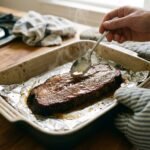
Most people who ruin flank steak don’t ruin it because they used the wrong marinade or the wrong pan. They ruin it because they pulled it off the heat at the wrong temperature. That’s it. A few degrees can mean the difference between a juicy, flavorful slice and a tough, chewy disaster that no amount of chimichurri can save.
Flank steak is one of those cuts that rewards precision. It comes from the abdominal muscles of the cow — a hardworking area, which means the meat is lean, full of long muscle fibers, and packed with beefy flavor. But that leanness is a double-edged sword. Cook it right, and you’ve got restaurant-quality steak at home. Overcook it, and you’re basically chewing on a leather belt.
So, what’s the magic number? What internal temperature tells you your flank steak is perfectly done? Let’s break it all down — doneness levels, cooking methods, resting, slicing, and every little detail that actually matters.
What Makes Flank Steak Different From Other Cuts?
Before we talk numbers, you need to understand why flank steak plays by slightly different rules than, say, a ribeye or a filet mignon.
Flank steak is a flat, wide, and relatively thin cut that comes from below the loin. It has very visible grain lines running through it — those long muscle fibers I mentioned. There’s minimal marbling (intramuscular fat), which means two things: it cooks faster than thicker cuts, and it doesn’t have that built-in fat cushion to keep it moist if you overcook it.
This is why temperature control is so critical with flank steak. A well-marbled ribeye can forgive you for going 5–10 degrees over your target. Flank steak won’t. It goes from tender to tough in a surprisingly narrow window.
It’s also why most chefs and grill experts recommend keeping flank steak at medium-rare to medium — and rarely beyond that. If you’re someone who normally eats steaks well done, flank steak might genuinely challenge that preference. But we’ll get into all of that below.
If you’re curious about how doneness levels work across different steak cuts, our steak doneness guide covers the full spectrum.
Flank Steak Done Temperature: The Exact Numbers
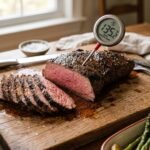
Alright, here’s what you came for. These are the internal temperatures for each doneness level, measured at the thickest part of the flank steak using an instant-read meat thermometer.
Rare: 120–125°F (49–52°C) — Cool red center. The steak will be very soft, almost squishy to the touch. Honestly, rare flank steak can feel a bit slippery in texture because the connective tissues haven’t had time to break down at all. Some people love it; others find it too raw for this particular cut.
Medium-Rare: 130–135°F (54–57°C) — Warm red center turning to pink. This is the sweet spot for flank steak, and most experienced cooks will tell you the same thing. At this temperature, the muscle fibers have relaxed just enough to be tender, the juices are fully distributed, and the beefy flavor is at its peak. If you’re unsure what to aim for, aim here.
Medium: 135–145°F (57–63°C) — Warm pink center throughout. Still a very solid choice for flank steak. You lose a tiny bit of juiciness compared to medium-rare, but the texture is a bit more “steak-like” for people who don’t enjoy any redness. The key is to stay closer to 140°F rather than pushing toward 145°F.
Medium-Well: 145–155°F (63–68°C) — Slight pink in the center, mostly gray-brown. Here’s where things start getting dicey with flank steak. The low fat content means the meat dries out noticeably at this stage. It’s still edible, sure, but you’ll feel the toughness compared to medium-rare.
Well Done: 155°F+ (68°C+) — No pink, gray-brown throughout. I won’t sugarcoat this: well-done flank steak is tough. The long muscle fibers contract and squeeze out moisture, and without marbling to compensate, you’re left with a dry, chewy result. If well done is your preference, a different cut like chuck or even a shoulder roast will serve you much better.
Pro Tip: Always pull your flank steak off the heat 5°F before your target temperature. The meat continues cooking as it rests — a process called carryover cooking. So if you want 135°F, pull it at 130°F.
Why Medium-Rare Is the Gold Standard for Flank Steak
You’ll hear this recommendation everywhere, and it’s not just chef snobbery. There’s actual food science behind it.
At around 130–135°F, a few important things happen inside the meat. The protein myosin starts to denature and coagulate, which gives the steak structure and that pleasant “cooked” texture. But at this temperature, another protein — actin — is still mostly intact. Actin is the protein that, once it fully denatures (around 150°F+), causes meat fibers to squeeze together and push out all the moisture.
So medium-rare is essentially the temperature where you get cooked flavor and texture without triggering the moisture-squeezing effect. That’s the science in simple terms.
There’s also the flavor factor. Flank steak has a deep, intense beefy taste — more so than tender cuts like tenderloin. That flavor is best experienced when the meat isn’t dried out. At medium-rare, every bite delivers that rich, almost mineral-like beef flavor that people love about this cut.
Does this mean you can’t cook it to medium? Not at all. Medium is perfectly fine, especially if you’ve marinated the steak well (a good acidic marinade with citrus or vinegar helps break down fibers). Just be aware that every degree past 140°F starts trading tenderness for toughness with this specific cut.
How to Check Flank Steak Temperature Accurately
Here’s something that surprises a lot of home cooks: the finger-poke test isn’t reliable. I know, I know — you’ve seen it in every cooking video. Press your thumb and index finger together, poke the fleshy part of your palm, compare it to your steak. It’s a fun party trick, but it’s wildly inconsistent because everyone’s hands are different, and steak thickness varies.
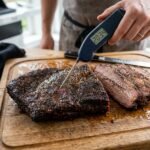
The only method that gives you real accuracy is a meat thermometer. An instant-read digital thermometer is ideal — they give you a reading in 2–3 seconds and they’re accurate within 1–2 degrees.
Here’s how to do it right with flank steak specifically:
Insert the thermometer probe from the side, going into the thickest part of the steak horizontally. Because flank steak is relatively thin (usually ¾ to 1½ inches thick), going in from the top can give you a misleading reading — the probe might pass through the meat too quickly or touch the cooking surface. Side insertion keeps the probe centered in the meat where the actual core temperature is.
Check the temperature at multiple spots if your flank steak is uneven in thickness. The thinnest parts will cook faster, and you want to make sure the thickest section has reached your target.
If you’re not sure you’re reading your thermometer correctly, our guide on how to read a meat thermometer walks through it step by step.
Cooking Methods and How They Affect Done Temperature
The target internal temperature stays the same regardless of how you cook your flank steak. But the method you use affects how quickly you get there, how much crust you develop, and how evenly the meat cooks. Let’s talk about the most popular approaches.
Grilling Flank Steak
This is probably the most common way people cook flank steak, and for good reason. High, direct heat creates a beautiful sear on the outside while the inside stays pink and juicy — exactly what you want.
Preheat your grill to high heat (450–500°F at the grate level). Place the flank steak directly over the heat and cook for about 4–6 minutes per side, depending on thickness. Don’t move it around constantly — let it sit and develop that crust.
Start checking the internal temperature around the 4-minute mark on the second side. You’re looking for 125–130°F if your target is medium-rare (remember carryover cooking will add about 5 degrees during resting).
One thing about grilling: because flank steak is thin and flat, it can go from perfect to overdone very quickly over high heat. Stay close to the grill. This isn’t a brisket you can walk away from for hours — if you’re curious about those longer cooks, check out when to pull brisket for that kind of patient cooking.
Pan-Searing Flank Steak
A screaming-hot cast iron skillet is the indoor equivalent of a blazing grill. Heat the pan over high heat until it just starts to smoke, add a high-smoke-point oil (avocado oil works great), and lay the steak away from you to avoid splatter.
Cook for 3–5 minutes per side. The pan gives you excellent crust development — arguably even better than a grill because there’s full contact between the meat and the hot surface. Check temperature the same way: probe from the side, aim for 125–130°F before resting.
A cast iron pan can also go straight from the stovetop into the oven if you want more controlled cooking on a thicker piece. Sear both sides on high heat for about 2 minutes each, then transfer to a 400°F oven until the internal temp hits your target.
Broiling Flank Steak
Your oven’s broiler is basically an upside-down grill. Set the rack about 4–6 inches from the broiler element, preheat for 5 minutes, and cook the steak for about 5–7 minutes per side.
Broiling gives decent results, though you won’t get quite as intense a crust as direct grilling or cast iron. Temperature targets remain the same.
Smoking Flank Steak
This is less common but gaining popularity, especially among backyard barbecue enthusiasts. Smoking flank steak at a lower temperature (225–250°F smoker temp) gives it a mild smoky flavor, but you need to be careful because the low-and-slow approach can dry out this lean cut if you’re not paying attention.
Smoke until the internal temperature hits 125°F, then pull it off and give it a quick sear on a hot grill or pan to develop a crust. Rest, slice, and serve. The smoking time will be roughly 1 to 1.5 hours depending on thickness and smoker consistency.
If you’re into smoking meats and want to understand wood flavor differences, our comparison of hickory vs mesquite wood is worth a read.
Sous Vide Flank Steak
Sous vide is honestly a cheat code for flank steak. You set the water bath to your exact target temperature (130°F for medium-rare), seal the steak in a vacuum bag, and let it cook for 2–4 hours. Because the water never exceeds your target temp, it’s literally impossible to overcook it.
The extended cooking time also helps break down some of the tougher connective tissue in flank steak without raising the temperature into the “tough and dry” zone. After sous vide, give it a 60-second sear per side on a blazing hot pan for color and crust.
This method is especially great if you’re nervous about overshooting your temperature. The margin for error is basically zero.
The Resting Phase: Don’t Skip This
I touched on this earlier, but it deserves its own section because so many people skip it.
After you pull your flank steak off the heat, let it rest for 5–10 minutes on a cutting board. Loosely tent it with foil — you don’t want to wrap it tightly or you’ll steam the crust and lose that texture.
Why does resting matter? When meat cooks, the heat pushes the juices toward the center. If you slice immediately, all those juices pour out onto the cutting board instead of staying in the meat. Resting gives the juices time to redistribute evenly throughout the steak.
During this resting period, the internal temperature will rise by about 3–7°F depending on how hot your cooking surface was. This is carryover cooking, and it’s exactly why you should pull the steak off before it reaches your target temp.
A flank steak that rests properly will have noticeably more juice in every bite compared to one that’s cut right away. It’s one of the simplest things you can do, and it makes a real difference.
How to Slice Flank Steak (Because Temperature Alone Isn’t Enough)
Here’s a truth that catches many people off guard: you can nail the internal temperature perfectly and still end up with tough flank steak if you slice it wrong.
Remember those long muscle fibers running through the meat? If you cut with the grain (parallel to those fibers), each bite will contain long, intact fibers that are hard to chew through. It’ll feel stringy and tough even at a perfect 130°F.
The fix is simple. Always slice flank steak against the grain — meaning your knife cuts perpendicular to those visible fiber lines. This shortens the fibers in each slice, making every bite tender.
Also, cut your slices thin, about ¼ inch thick. Thick slices of flank steak are inherently chewier because you’re biting through more fiber. Thin slices melt in your mouth comparatively.
Hold your knife at a slight angle (about 45 degrees) rather than cutting straight down. This creates wider slices with more surface area, which look better on the plate and feel more tender to eat.
If you’re interested in slicing techniques for different cuts, our article on how to slice brisket covers similar principles about grain direction and knife angle.
What If You Overcooked Your Flank Steak?
It happens to everyone. You got distracted, the heat was higher than you thought, or you just misjudged the timing. Your thermometer reads 160°F and your heart sinks a little.
Don’t toss it. There are ways to salvage overcooked flank steak.
Slice it extra thin. Ultra-thin slices reduce the toughness factor significantly. A sharp knife is essential here — a dull blade will tear the fibers instead of cutting cleanly, making the texture even worse.
Add moisture back. A quick drizzle of good olive oil, melted butter, or a flavorful sauce (chimichurri, teriyaki glaze, or a simple pan sauce) can compensate for some of the lost juiciness. You’re not fixing the texture, but you’re making the eating experience much more pleasant.
Repurpose it. Overcooked flank steak sliced thin works surprisingly well in tacos, stir-fry, fajitas, or on top of a salad. When the meat is combined with other moist ingredients, sauces, and toppings, the dryness becomes much less noticeable.
The best fix, though, is prevention. Use a thermometer next time. Seriously. Even professional chefs use thermometers — the ones who say they don’t are either lying or have cooked the same cut so many thousands of times that they’ve developed an intuitive sense that most home cooks simply haven’t had the chance to build.
Flank Steak vs. Other Cuts: Temperature Comparison
It helps to see where flank steak sits relative to other popular cuts, because the ideal doneness temperature actually varies based on the cut’s fat content and fiber structure.
A ribeye, for example, has heavy marbling. You can comfortably cook it to medium (140–145°F) without it drying out because all that intramuscular fat keeps it moist. A tri-tip is similar to flank in leanness but is thicker, so it cooks differently — you can learn about tri-tip internal temperature for the specifics on that cut.
Ground beef patties, like hamburgers, follow different rules entirely because the grinding process changes the safety equation. Bacteria can exist throughout ground meat (not just the surface), which is why the recommended safe temperature for a hamburger internal temperature is 160°F — significantly higher than what you’d aim for with a whole-muscle steak like flank.
Whole-muscle steaks like flank are considered safe at lower internal temperatures because bacteria only live on the exterior surface, which gets killed during the searing process. That’s why it’s perfectly safe to eat a flank steak at 130°F internally, even though ground beef needs to reach 160°F.
Marinating and Seasoning: How They Affect Cooking
A quick word on marinating, because it’s closely connected to your temperature decisions.
Acidic marinades — those containing vinegar, citrus juice, wine, or yogurt — partially break down muscle fibers on the surface of the meat. This can give you a slight tenderness advantage, especially if you’re planning to cook to medium rather than medium-rare.
But here’s the catch: don’t over-marinate flank steak. Two to four hours is ideal. Beyond 8–12 hours, the acid starts to break down the surface fibers too much, creating a mushy, mealy texture on the outside while the interior stays unchanged. It’s an unpleasant contrast.
If you’re using a simple salt-and-pepper rub (which honestly is all flank steak really needs), salt the steak at least 40 minutes before cooking, or right before it hits the heat. Salting between 5 and 40 minutes is the worst window — the salt draws out moisture to the surface, and if you cook during that period, the surface moisture prevents a good sear. After 40 minutes, the salt has been reabsorbed along with the moisture, and the surface is dry again. Dry surface = better crust = better steak.
Common Mistakes That Mess Up Your Flank Steak
Even with perfect temperature awareness, a few common errors can undermine your results.
Cooking it cold from the fridge. Take the steak out 20–30 minutes before cooking. A cold steak hits a hot pan and the exterior overcooks before the interior even starts warming up, giving you a gray band of overcooked meat around a raw center. Room-temperature meat cooks more evenly.
Not preheating enough. Whether it’s a grill, pan, or broiler — the cooking surface needs to be ripping hot before the steak goes on. A medium-heat pan won’t sear; it’ll steam. You want to hear an aggressive sizzle the moment the meat touches the surface.
Poking it with a fork or cutting into it to check. Every puncture lets juices escape. Use a thermometer instead. And please, don’t cut into the steak “just to peek” — that’s the biggest juice-loss move you can make.
Slicing with the grain. We covered this already, but it’s worth repeating because it’s the single most common mistake. Even perfectly cooked flank steak will taste tough if you cut it wrong.
FAQ
Is flank steak safe to eat at 130°F?
Yes. The USDA considers whole-muscle beef steaks safe at lower internal temperatures than ground beef because bacteria reside only on the surface, which is destroyed during high-heat cooking. Many restaurants serve flank steak at 130°F (medium-rare) regularly. That said, individuals with compromised immune systems, pregnant women, or young children should consult with a healthcare professional about consuming meat at lower temperatures.
How long does it take to cook flank steak to medium-rare?
It depends on thickness and cooking method. On a hot grill or cast iron pan, a typical flank steak (about 1 inch thick) reaches medium-rare (130–135°F) in roughly 8–12 minutes total (flipping once). Sous vide takes 2–4 hours at a controlled 130°F, while broiling runs about 10–14 minutes. Always rely on a thermometer rather than time alone.
Can I cook flank steak well done and still keep it tender?
It’s very difficult with this cut. Flank steak is lean with minimal marbling, so once the internal temperature passes 155°F, it tightens up significantly. If you prefer well-done beef, a fattier cut like chuck roast or even a heavily marbled ribeye will hold up much better. If you must cook flank steak past medium, slice it as thin as possible and serve it with a sauce to add back some moisture.
What’s the difference between flank steak and skirt steak temperatures?
Both are lean, flat cuts, and the ideal internal temperatures are very similar — medium-rare (130–135°F) is recommended for both. The main difference is that skirt steak is typically thinner than flank steak, so it cooks faster (sometimes under 2 minutes per side on high heat). The grain direction also runs differently, so pay attention when slicing.
Should I use a leave-in thermometer or an instant-read for flank steak?
An instant-read thermometer is better for flank steak because the cut is thin and cooks quickly. Leave-in probe thermometers work best for thick roasts or briskets where cooking times are long. With flank steak, you want quick spot-checks during the last few minutes of cooking rather than a probe sitting in a thin piece of meat that might give inaccurate readings due to proximity to the cooking surface.
Your Flank Steak, Your Call
Flank steak is one of those beautiful cuts that delivers huge flavor without a huge price tag. But it demands respect in the form of temperature awareness. Pull it at 125–130°F for medium-rare, let it rest, slice against the grain, and you’ll produce something that genuinely rivals what you’d get at a steakhouse.
Get yourself a reliable instant-read thermometer if you don’t already have one. It’s a small investment that takes the guesswork out of every steak, burger, or roast you’ll ever cook. And if you’re building your meat-cooking skills across the board, explore how different meats hit their ideal temperatures — the principles carry over, but the numbers change, and knowing them makes all the difference.
Your next flank steak is going to be the best one you’ve ever made. Trust the thermometer, trust the rest, and trust the slice.