Here’s a number that can make or break your brisket: 165°F. That’s roughly where most pitmasters wrap their brisket, and missing this window by even 10–15 degrees can mean the difference between melt-in-your-mouth bark and a dried-out disappointment.
But here’s the thing — it’s not just about hitting a single magic number. Your wrap temperature depends on what kind of bark you want, what you’re wrapping with, and how your specific smoker behaves. I’ve seen people wrap too early and end up with soggy bark, and I’ve seen folks wait too long and wonder why their brisket turned into beef jerky.
So let’s break this down properly. No fluff, no guessing games — just the real information you need to nail your brisket wrap every single time.
Why Wrapping Your Brisket Actually Matters
Before we talk numbers, you need to understand why wrapping exists in the first place. It’s not some arbitrary BBQ ritual — there’s actual science behind it.
When a brisket hits somewhere around 150°F to 170°F, it enters what’s called “the stall.” The internal temperature just… stops climbing. Sometimes for hours. This happens because moisture on the meat’s surface evaporates, cooling the brisket down at the same rate your smoker is heating it up. Think of it like sweating on a hot day — your body cools itself, and the brisket does something similar.
Wrapping creates a barrier that traps that moisture. The evaporation slows down dramatically, and the internal temp starts climbing again. Without wrapping, you could be staring at your thermometer for 4–6 extra hours waiting for the stall to pass naturally.
But wrapping does more than just speed things up. It also keeps rendered fat and juices pressed against the meat, essentially braising the brisket in its own liquid. That’s where the tenderness comes from. If you’ve ever had a brisket that was technically cooked but still tough and chewy, there’s a good chance it spent too long exposed during the stall and lost too much moisture.
There’s a trade-off, though. Wrapping softens the bark. The crispy, dark, peppery exterior you worked hard to build gets steamed inside that wrap. How much it softens depends on your wrap material — but we’ll get to that shortly.
The Ideal Temperature To Wrap Brisket
Let’s get straight to the number everyone’s looking for.
The sweet spot for wrapping brisket is between 165°F and 170°F internal temperature.
This range works because your bark has had enough time to set properly, the stall is either about to hit or just starting, and the meat has absorbed plenty of smoke flavor by this point.
Some competition pitmasters push it to 175°F before wrapping, especially if they want a firmer bark. Aaron Franklin — arguably the most famous brisket cook alive — has mentioned wrapping around 165°F–170°F. But he also emphasizes that he goes by look and feel as much as temperature.
Here’s a quick reference for different scenarios:
Wrap at 150°F–160°F — You’ll get through the stall faster, but your bark won’t be fully developed. The texture will be softer, almost pot-roast-like. Some people actually prefer this for pulled brisket sandwiches.
Wrap at 165°F–170°F — The sweet spot. Bark is set, smoke ring is established, and you catch the stall right as it begins. This gives you the best balance of flavor, texture, and cooking time.
Wrap at 175°F–180°F — Maximum bark development. Your crust will be thicker and crunchier, but you’ll spend more time in the stall. This works if you started early and have plenty of time, or if you’re using butcher paper and want that aggressive bark.
If you want more details on overall brisket temperatures, check out our brisket wrap temperature guide for a deeper breakdown.
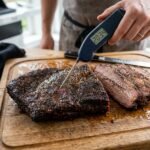
⚠️ Pro Tip: Don’t rely on just one thermometer reading. Brisket isn’t uniform — the flat and the point cook at different rates. Probe the thickest part of the flat for your wrap decision, since that’s the section most vulnerable to drying out.
How the Stall Affects Your Wrap Timing
Understanding the stall isn’t optional if you want great brisket. It’s the single biggest reason wrapping exists.
The stall typically begins between 150°F and 170°F. Your smoker is pumping heat into the meat, but evaporative cooling is pushing back just as hard. The temperature flatlines. On a 14-hour cook, the stall alone can eat up 3–5 hours if you don’t wrap.
Here’s what’s actually happening inside the meat during the stall: collagen is starting to break down into gelatin, fat is slowly rendering, and moisture is migrating to the surface. All of this is good — it’s what makes brisket tender. But too much moisture loss during this phase dries out the final product.
Wrapping at 165°F–170°F catches the stall early. You don’t eliminate the collagen breakdown process — that continues inside the wrap. You just remove the evaporative cooling effect so the temperature can keep climbing toward your final target of around 200°F–210°F.
One thing I see beginners mess up: they wrap based purely on time, not temperature. “I’ve been smoking for 5 hours, time to wrap!” That’s a recipe for inconsistency. A 12-pound packer brisket and an 8-pound flat are going to hit 165°F at very different times. Always go by internal temp.
If you’re smoking at a lower temperature like 225°F, the stall will last longer because there’s less thermal energy pushing through the evaporative barrier. Our guide on smoking brisket at 225 covers how to manage timing at that temperature. On the flip side, if you’re running your smoker hotter — say 275°F — the stall is shorter but still present.
Butcher Paper vs. Aluminum Foil: Which Wrap To Use
The material you use changes the game significantly. This isn’t a minor detail — it affects bark texture, moisture levels, and even cook time.
Aluminum Foil (The Texas Crutch)
Foil creates a near-complete seal. Almost zero moisture escapes, which means your brisket pushes through the stall quickly and the meat stays extremely moist. The downside? Your bark takes a hit. That crispy, crunchy exterior softens considerably because steam has nowhere to go.
Foil works well if you’re behind schedule, if you prefer a softer texture, or if you plan to make chopped brisket or sandwiches where bark texture is less critical. It can cut 1–2 hours off your total cook time compared to butcher paper.
When using foil, wrap tightly. You want the foil pressed against the meat with no air pockets. Double-layering with heavy-duty aluminum foil prevents tears.
Butcher Paper (The Pitmaster’s Choice)
Pink butcher paper (also called peach paper) is what most Texas-style pitmasters reach for. It’s breathable — moisture can escape slowly, which means your bark stays intact while you still get protection from the stall.
The result is a brisket with a firmer, more developed bark and slightly less moisture than a foil-wrapped brisket. But that “slightly less moisture” is barely noticeable if you’ve cooked it right. The bark difference, though? Very noticeable.
Make sure you’re using unwaxed, uncoated, food-grade pink butcher paper. Regular brown paper bags or waxed butcher paper won’t work — they can either burn, melt, or transfer chemicals. If you’re unsure about the differences between wrapping materials, our comparison of butcher paper vs. parchment paper clears that up.
No Wrap at All (Naked Brisket)
Yes, this is an option. Some old-school pitmasters never wrap. You get maximum bark development and maximum smoke flavor. But you need patience — the stall will run its full course. You also need a fattier brisket (a full packer with a thick fat cap) because leaner cuts will dry out without wrapping.
Naked briskets work best on offset smokers where you have excellent temperature control and can keep things steady at 225°F–250°F for 12–16 hours. If you’re using a pellet grill or a less insulated smoker, wrapping is the safer bet.
Step-by-Step: How To Wrap Brisket at the Right Temperature
Let me walk you through the actual process because technique matters as much as timing.
Before you start cooking, get your wrapping material ready. If you’re using butcher paper, tear off two sheets that are each about 4 times the length of your brisket. If you’re using foil, tear off two sheets of heavy-duty foil, same length.
While smoking, monitor internal temperature with a reliable probe thermometer inserted into the thickest part of the flat. Not the point — the flat. Knowing where to probe your brisket is critical for accurate readings.
When the internal temp hits 165°F–170°F, here’s what you do:
Pull the brisket from the smoker and place it on your wrapping material, presentation side down (fat cap facing up if you’ve been cooking fat cap up). Work quickly — you don’t want the surface cooling down too much.
For butcher paper: fold the bottom edge up over the brisket, tuck tightly, roll the brisket forward while folding the sides in like a burrito. Roll until fully wrapped. The paper should be snug but not crushing the bark.
For foil: place the brisket in the center, bring both long sides up and crimp together tightly, then fold the short ends under. No air gaps. Some pitmasters add a splash of beef tallow, apple juice, or just plain beef broth before sealing — maybe 2–3 tablespoons. This creates extra steam and adds flavor.
Place the wrapped brisket back in the smoker, seam side down so it doesn’t unwrap. Re-insert your temperature probe through the wrapping material.
Continue cooking until the internal temperature reaches 200°F–205°F and the probe slides in like it’s going through warm butter. Temperature alone isn’t enough — that probe tenderness test is what tells you the collagen has fully broken down.
What Happens If You Wrap Too Early or Too Late
Getting the timing wrong isn’t the end of the world, but it does change your final product in predictable ways.
Wrapping Too Early (Below 150°F)
Your bark won’t have set yet. The Maillard reaction — that browning process that creates flavor and texture on the surface — needs time and heat exposure. Wrap before 150°F and your brisket will taste more like a braised roast than a smoked one. The smoke ring will be thinner too, since smoke absorption slows down dramatically once you wrap.
If you accidentally wrap early, you can unwrap the brisket for the last 20–30 minutes of cooking to try to crisp the bark back up. It won’t be the same as a properly developed bark, but it helps.
Wrapping Too Late (Above 180°F)
By the time you hit 180°F unwrapped, a lot of moisture has already left the brisket. The stall has done most of its damage. You’ll get a great bark, but the meat might be drier than you want, especially in the flat section.
If you find yourself in this situation, adding a bit of beef tallow or broth inside the wrap can help compensate for the lost moisture. It’s a recovery move, not a prevention strategy — but it works.
Choosing the Right Smoker Temperature for Your Wrap
Your smoker temperature affects when you’ll hit that wrap point. This is a relationship a lot of people overlook.
At 225°F, a 12-pound packer brisket typically takes about 6–8 hours to reach 165°F internal. The bark development is slow and even, and you get deep smoke penetration. This is the traditional approach, and it gives you maximum control.
At 250°F, you’ll reach the wrap point in roughly 5–7 hours. This is what most backyard smokers run because it’s a nice balance between time and quality. The bark develops a bit faster, and the total cook time drops by about an hour compared to 225°F.
At 275°F, things move noticeably quicker. You might hit 165°F in 4–5 hours. The bark can be slightly less uniform because the higher heat creates more contrast between edges and center, but plenty of great briskets come off smokers running at this temperature. For tips on managing higher smoking temperatures, you might find our best temp to smoke brisket guide useful.
No matter what temperature you run, the wrap temperature stays the same: 165°F–170°F internal. Your smoker temp changes how long it takes to get there, not where you should be when you wrap.
What To Do After You Wrap: The Rest Period
Wrapping doesn’t end when the brisket comes off the smoker. What you do next is just as important.
Once your brisket hits 200°F–205°F and passes the probe test, pull it off the smoker. Keep it wrapped. Now comes the rest — and this part is non-negotiable if you want the best results.
Place the wrapped brisket in a dry cooler (no ice) lined with old towels. Close the lid. Let it rest for a minimum of 1 hour, though 2–4 hours is better. Some competition teams rest for up to 6 hours in a cooler, and the brisket stays hot enough to serve safely the entire time.
During the rest, the internal temperature drops slowly to around 145°F–155°F. Juices redistribute throughout the meat. If you slice too early, those juices pour out onto your cutting board instead of staying in the meat. You’ll see a pool of liquid and wonder where all that moisture went — it went onto wood instead of into your mouth.
When you’re ready to slice, unwrap the brisket and slice it properly. Always cut against the grain. The flat and point have different grain directions, so pay attention when you transition between the two sections.
And if you end up with leftovers (lucky you), our guide on how to reheat brisket will help you bring it back to life without drying it out.
Reading Your Brisket: Beyond Just Temperature
Here’s something that separates good cooks from great ones: knowing when to trust your eyes and hands over the thermometer.
Temperature gives you a reliable guideline, but brisket is a living piece of meat (well, it was). Each one is different. Fat content varies. Thickness varies. Grade matters — a Prime brisket handles heat differently than a Choice, and a full packer behaves differently than just the flat.
When you’re checking whether it’s time to wrap, look at these things alongside your thermometer:
Bark color. You want a deep mahogany, almost dark brown. If the bark is still light reddish, it needs more time regardless of what the thermometer says.
Bark texture. Touch it with a gloved finger. It should feel firm and slightly tacky, not wet or soft. A set bark can handle being wrapped without falling apart.
Fat rendering. Look at the fat cap. If it’s still waxy and white, the brisket isn’t ready to wrap. You want to see it starting to turn translucent and soft.
Smoke absorption. By 165°F, the meat has absorbed about 80% of the smoke flavor it’s going to take on. The smoke ring is essentially locked in at this point, so wrapping won’t reduce your smoke flavor in any meaningful way.
Knowing how to read your meat thermometer accurately is also essential. A thermometer that’s off by 5 degrees can throw your entire timing off.
A Quick Word on Brisket Selection
Your wrap temperature stays the same regardless of brisket type, but the brisket you buy affects how forgiving the process is.
A full packer (point and flat connected, usually 12–18 pounds) has more intramuscular fat and is more forgiving if you wrap a few degrees late. The point section has enough marbling to stay moist even without wrapping.
A flat-only cut (usually 6–10 pounds) is leaner and less forgiving. If you’re cooking just a flat, lean toward wrapping at 160°F–165°F rather than pushing to 170°F+. There’s less fat to protect the meat, so you need that wrap barrier sooner.
Knowing what part of the cow brisket comes from helps you understand why it needs low-and-slow cooking and why wrapping is so helpful for this particular cut. It comes from the chest, a heavily worked muscle with lots of connective tissue — which is exactly what needs time and moisture to break down into tenderness.
FAQ
Can I wrap brisket at 150°F instead of 165°F?
You can, but your bark won’t be fully developed. At 150°F, the surface hasn’t had enough heat exposure to form a firm crust, so wrapping this early usually results in a softer, less defined bark. If bark texture is important to you, wait until at least 160°F–165°F.
Does it matter if I use foil or butcher paper for wrapping?
Yes, significantly. Aluminum foil traps all moisture and pushes through the stall faster, but it softens the bark. Butcher paper lets some moisture escape, keeping the bark firmer while still protecting against excessive drying. Most Texas-style pitmasters prefer butcher paper for this reason.
How do I know when my brisket is done after wrapping?
The target internal temperature is 200°F–205°F, but don’t rely on temperature alone. Insert your probe into the thickest part of the flat — it should slide in with almost no resistance, like poking softened butter. If there’s any tightness or resistance, keep cooking even if the temp reads 203°F.
Should I add liquid when wrapping my brisket?
It’s optional but can help, especially with foil. A couple tablespoons of beef tallow, broth, or apple juice adds moisture and flavor. With butcher paper, most pitmasters skip the liquid since the paper already allows some moisture to breathe naturally.
What if my brisket stalls before 165°F?
This is actually pretty common. Some briskets start stalling as early as 150°F. If the stall begins and your bark looks and feels ready — firm, dark, set — go ahead and wrap even if you haven’t quite hit 165°F. The bark readiness matters more than an exact number.
Your Next Cook Starts Here
The temperature to wrap your brisket — 165°F to 170°F — is one of those pieces of knowledge that immediately levels up your BBQ game. But remember, that number is a guideline, not a law. Your eyes, your hands, and your experience matter just as much as any thermometer.
Start with 165°F on your next cook. Pay attention to how the bark looks and feels at that temperature. Take mental notes. After two or three briskets, you’ll start developing your own instinct for when wrapping time hits — and that’s when you go from following a recipe to actually knowing what you’re doing.
Fire up that smoker. Your best brisket is one cook away.