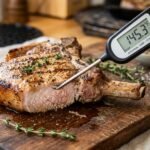
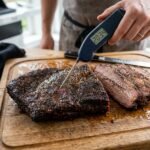
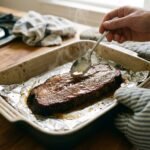
Most people yank their brisket off the smoker way too early — right around 195°F — and then wonder why the meat feels stiff, chewy, and nowhere close to that melt-in-your-mouth texture they see on Instagram. The real magic? It usually happens around brisket internal temp 210°F, give or take a few degrees.
But here’s the thing — 210 isn’t just a random number. There’s actual science behind why brisket transforms at this temperature. Collagen breaks down, fat renders out, and tough muscle fibers turn soft and silky. If you’ve been guessing your brisket doneness by time alone or just “eyeballing” it, you’re leaving a lot on the table.
This guide walks you through exactly what happens inside your brisket at 210°F, how to know if your specific cut needs a bit more or less, and what mistakes can ruin even a perfectly temped brisket.
What’s So Special About 210°F for Brisket?
Brisket is one of the toughest cuts you can buy. It comes from the chest area of the cow — a muscle that does heavy work throughout the animal’s life. That means it’s loaded with connective tissue, collagen, and intramuscular fat. These are the same things that make it tough raw but incredible when cooked right.
If you want to understand what part of the cow brisket comes from, that context helps you appreciate why this cut demands patience.
Here’s what happens at different temperature stages inside a brisket:
Around 160–170°F, collagen starts breaking down, but slowly. This is also the dreaded “stall” zone where your brisket’s internal temp seems stuck for hours. Between 195–203°F, you get noticeable tenderness. A lot of competition pitmasters pull here. But at 205–210°F, the collagen-to-gelatin conversion hits its peak. The rendered fat and gelatin lubricate every fiber of the meat, creating that juicy, fork-tender pull-apart texture that makes people lose their minds.
So 210°F isn’t about cooking the meat “more.” It’s about giving the collagen enough time and heat to fully convert into gelatin. That’s the difference between a good brisket and one that makes people go silent because they’re too busy eating.
Should You Always Pull Brisket at 210°F?
Short answer — not always. And this is where a lot of home smokers get tripped up.
210°F is a target range, not a rigid rule. Some briskets are perfectly tender at 203°F. Others need to go to 212°F before they feel right. Why the variation? Because every brisket is different. The grade of beef matters. A prime brisket has more marbling than a choice grade, which means it renders differently and may reach tenderness at a slightly lower temp.
The thickness of the flat, the size of the point, even how the animal was raised — all of this affects the final magic number.
Pro Tip: Temperature is your guide, but the probe test is your final answer. When your thermometer slides into the thickest part of the brisket like a hot knife through butter — with zero resistance — your brisket is done. If you hit 210°F and there’s still some resistance, let it ride a few more degrees.
Knowing when to pull your brisket is really about combining your thermometer reading with that physical feel. Numbers get you close. Your hands and probe get you home.
The Role of Your Smoker Temperature
Your smoker’s cooking temperature directly impacts how your brisket behaves at 210°F internal.
If you’re smoking brisket at 225°F, the process is slow and gentle. Collagen has more time to break down gradually, fat renders evenly, and you typically get a more forgiving cook. The bark develops beautifully because the surface has hours to build that crusty, flavorful layer.
Bump your smoker up to 275°F or higher, and things move faster. You can still hit 210°F internal, but the journey there is different. Fat might not render as completely, and there’s less room for error. The brisket might hit 210°F on the thermometer but still feel slightly tighter than one cooked low and slow.
Think of it like this — two cars can both reach the same destination, but the one taking the scenic route arrives with a smoother ride.
For most home cooks, the sweet spot for smoker temperature is somewhere between 225°F and 250°F. That range gives you the best balance of time, tenderness, and bark formation. If you’re pressed for time, 275°F works — just watch your brisket more closely as it approaches the 200°F-plus range.
How to Accurately Measure Brisket Internal Temperature
You could have the best smoker, the finest prime brisket, and perfect weather — and still mess things up with a bad temperature reading. Where and how you probe your brisket makes a huge difference.
The thickest part of the flat is your primary probe point. This is the leanest, most unforgiving section of the brisket. If the flat is tender at 210°F, the fattier point section is almost certainly done too.
Avoid probing near fat pockets or right along the fat cap — you’ll get a misleading reading. You also don’t want to probe too close to the edge, where the meat is thinner and cooks faster. Get your thermometer right into the center mass of the flat, roughly mid-way through the thickness.
If you’re unsure about thermometer accuracy or probe placement, this guide on reading meat thermometers and understanding where to probe brisket will clear things up fast.
Quick fact: Cheap thermometers can be off by 5–10 degrees. That’s the difference between a brisket that’s done and one that needs another 30–45 minutes. Invest in a reliable instant-read thermometer — ThermoWorks and ThermoPro are both trusted names among serious pitmasters.
To Wrap or Not to Wrap — and How It Affects 210°F
Wrapping your brisket is one of the biggest decisions you’ll make during a cook, and it directly affects how your brisket reaches and behaves at 210°F internal.
Most pitmasters wrap somewhere between 160–170°F internal — right when the stall kicks in. Wrapping does two things: it speeds up the cook by trapping moisture and heat, and it keeps the brisket juicier because less moisture escapes.
If you wrap in butcher paper, you get faster cooking while still allowing some bark to stay firm. The paper breathes just enough to prevent the bark from going soggy. If you use aluminum foil (the “Texas Crutch”), the brisket steams inside, gets very juicy, but the bark can soften significantly.
There’s actually a noticeable difference in how the brisket reaches 210°F depending on your wrapping method. A foil-wrapped brisket might hit 210°F 60–90 minutes sooner than an unwrapped one. A butcher paper wrap falls somewhere in between.
Want to dive deeper into wrapping strategies? Check out this breakdown on brisket wrap temperature and technique and the differences between butcher paper and parchment paper for smoking.
Warning: If you don’t wrap at all, your brisket will still reach 210°F — it’ll just take longer, and the flat might dry out, especially on leaner choice-grade briskets. Going naked (unwrapped) works best when you have a well-marbled piece of meat and a smoker that holds moisture well, like an offset or a ceramic kamado.
Flat vs. Point: They Don’t Hit 210°F the Same Way
Here’s something that trips up a lot of people, especially those cooking a full packer brisket — the flat and the point are two very different pieces of meat that just happen to be connected.
The flat is leaner, thinner, and more uniform. It dries out faster and is less forgiving. The point is thicker, fattier, and more marbled. It’s the section that makes incredible burnt ends.
When you probe the flat at 210°F and it feels probe-tender, the point is usually well past 210°F internally — sometimes sitting at 215°F or higher. And that’s fine. The extra fat in the point protects it from drying out, even at higher internal temps.
The mistake? Probing the point instead of the flat and pulling the whole brisket early. Your point might read 205°F and feel soft, while your flat is still at 195°F and stubbornly firm.
Always make the flat your benchmark. If you’re working with a flat vs. a full packer, this distinction matters even more because a standalone flat has less insulation from surrounding fat.
The Rest Period: What Happens After 210°F
Pulling your brisket at 210°F is only half the battle. What you do in the next 1–4 hours determines whether all that hard work pays off or falls flat (pun intended).
When you rest a brisket, residual heat continues cooking the meat for a bit — the internal temp might climb another 3–5 degrees before starting to drop. This is called carryover cooking. If you’re worried about overshooting, you can pull your brisket at 207–208°F and let carryover bring it to 210°F or just above.
The minimum rest time should be 1 hour. But honestly, 2–4 hours in a cooler (wrapped in towels, inside a pre-warmed cooler) produces the best results. During this extended rest, the juices — which are under pressure from the heat — redistribute throughout the meat. Cut into a brisket too soon and those juices pour out onto your cutting board. Rest it properly and they stay locked inside each slice.
Did you know? Aaron Franklin, one of the most respected brisket pitmasters in Texas, has said that the rest period is just as important as the cook itself. Some BBQ joints rest their briskets for 8+ hours in special holding ovens set at 140–150°F.
If you’ve ever had brisket that was technically cooked right but still felt dry when sliced, the culprit was almost certainly an inadequate rest.
How to Slice Brisket After It Hits 210°F
You’ve cooked it perfectly. You’ve rested it patiently. Now don’t blow it with bad slicing.
Brisket has grain — long muscle fibers running in a specific direction. Your job is to cut against the grain, which shortens those fibers and makes each bite tender. Cut with the grain and even a perfectly cooked 210°F brisket will feel chewy and stringy.
Here’s the tricky part: the grain direction changes between the flat and the point. On the flat, the grain runs lengthwise. On the point, it runs at a different angle, sometimes almost perpendicular to the flat’s grain. When you reach the section where the flat and point overlap, you’ll need to adjust your slicing angle.
Aim for slices about the thickness of a pencil — roughly ¼ inch. Too thin and they fall apart. Too thick and you lose that melt-in-your-mouth quality.
For a detailed visual walkthrough, this brisket slicing guide covers the flat, point, and that tricky transition zone between them.
What If Your Brisket Goes Past 210°F?
Don’t panic. A brisket at 212°F or even 215°F isn’t ruined. Plenty of excellent briskets come off the smoker above 210°F — especially the point section, which handles higher temps without drying out.
Where you run into trouble is if the flat pushes past 215°F without adequate fat or wrapping to protect it. At that point, the lean flat can start losing moisture rapidly and begin to feel dry and crumbly rather than tender and sliceable.
If you realize your flat has overshot, here’s what you can do. Wrap it tightly if you haven’t already. Rest it longer — the extended rest helps redistribute whatever moisture is left. And when you serve it, a drizzle of beef tallow, au jus, or even a good BBQ sauce can bring back some of that lost juiciness.
The point is much more forgiving. You can push a well-marbled point to 215°F+ and it’ll still be juicy and luscious. That’s exactly why pitmasters take the point even further for burnt ends.
Common Mistakes That Ruin a 210°F Brisket
Getting to 210°F internal means nothing if you’ve made critical errors along the way. Here are the most common ones:
Cooking by time, not temperature. “One hour per pound” is a rough estimate at best. Briskets are unpredictable. The stall alone can throw your timeline off by 2–4 hours. Always cook to temp and probe feel.
Not accounting for the stall. Somewhere between 155–170°F, your brisket’s internal temperature will plateau — sometimes for 3–5 hours. New smokers think something’s broken. It’s not. Evaporative cooling is doing its thing. Be patient or wrap your brisket to push through faster.
Opening the smoker too often. Every time you lift the lid, you lose heat and extend the cook time. Get a good wireless thermometer and stop peeking.
Skipping the rest. We covered this above, but it bears repeating. Cutting immediately after pulling is the single most common mistake that turns a great cook into a mediocre plate.
Using the wrong wood. Brisket pairs best with hardwoods like oak, hickory, or mesquite. Fruitwoods like apple and cherry are milder — they work, but won’t give you that deep, robust smoke flavor that beef loves.
Brisket Temperature Guide at a Glance
For quick reference, here’s how brisket behaves at key internal temperatures:
At 150–170°F, the stall begins. Collagen is starting to break down slowly, and moisture is evaporating from the surface. This is your wrapping window.
At 190–195°F, the brisket is getting close. Some thinner sections might probe tender, but the thickest part of the flat probably isn’t ready yet.
At 200–205°F, many briskets reach tenderness here, especially well-marbled prime cuts or smaller flats. Always probe-test.
At 205–210°F, this is the sweet spot for most full packer briskets. Collagen has fully converted to gelatin, fat is rendered, and the meat should feel like probing warm butter.
At 210–215°F, perfectly fine for the point section. The flat is at its limit here — if it’s still not tender by 212°F, something else went wrong (likely a tough, lean piece of meat that needed brining or injection).
Speaking of brining — if you’re wondering whether brining a brisket before smoking makes a difference, it absolutely can, especially for leaner cuts that struggle with moisture.
FAQ
Is 210°F too high for brisket?
Not at all — 210°F is right in the ideal range for most briskets, especially full packers. The collagen-to-gelatin conversion peaks between 200–210°F. As long as your probe slides in smoothly with no resistance, you’re golden. The point section can even go a bit higher without issues.
How long does it take brisket to reach 210°F internal?
That depends on your smoker temperature, the size of your brisket, and whether you wrap. A rough estimate for a 12–14 lb packer at 225°F is 12–18 hours, including the stall. Wrapping can shave off 2–4 hours. Always go by temperature, never by time alone.
Should I pull brisket at 203 or 210?
There’s no single right answer. Some briskets are probe-tender at 203°F — if yours is, pull it. Others need to hit 210°F before the connective tissue fully breaks down. The probe test matters more than the exact number. Develop a feel for it over a few cooks and you’ll start knowing exactly when your specific brisket is ready.
What if my brisket stalls before reaching 210°F?
The stall is normal and happens to every brisket. It usually occurs between 155–170°F and can last several hours. You can wait it out, or wrap your brisket in butcher paper or foil to push through faster. Either way, your brisket will eventually move past the stall and climb toward your target of 210°F.
Can I rest brisket in the oven instead of a cooler?
Yes. Set your oven to its lowest setting — ideally around 150–170°F — and rest the wrapped brisket inside. This is actually what many BBQ restaurants do with their holding cabinets. A cooler wrapped in towels works just as well for home cooks and can hold temperature for 4+ hours.
Your Brisket, Your Rules
Hitting brisket internal temp 210°F is a reliable target that works for the vast majority of cooks, cuts, and smokers. But the real skill isn’t just watching a thermometer climb — it’s understanding what’s happening inside the meat at every stage and adjusting based on what your specific brisket needs.
Start with 210°F as your benchmark. Use the probe test as your final check. Give your brisket a proper rest. And slice it right.
Do those things consistently and you won’t just cook brisket — you’ll cook brisket that makes people ask for your secret. And the secret? Patience, temperature awareness, and trusting the process.
Now fire up that smoker and put everything you’ve learned to work. Your next brisket is going to be the best one yet.