Most backyard pitmasters start their pork shoulder journey at 225°F — low, slow, and classic. But here’s the thing. A lot of experienced smokers have quietly moved to 275°F, and the results? Just as tender, just as juicy, and done hours sooner. If you’ve got an 8-pound pork shoulder sitting in your fridge right now and you’re wondering exactly how long it’ll take at 275, you’re in the right place.
The short answer: plan for about 60 to 80 minutes per pound when you smoke pork shoulder at 275°F. So an 8-pound shoulder will take roughly 8 to 10.5 hours. But that number alone won’t get you perfect pulled pork. There’s a lot more going on — the stall, wrapping decisions, internal temperature targets, and a few small tricks that separate okay pulled pork from the kind people talk about for weeks.
Let me walk you through all of it.
Why 275°F Works So Well For Pork Shoulder
There’s a reason 225°F became the “gold standard” for smoking — it’s what competition BBQ circuits popularized for decades. But 275°F isn’t some shortcut hack. It’s a legitimate cooking temperature that the pros use regularly, and there’s actual science behind why it produces excellent results.
Pork shoulder (also called pork butt — confusing, I know) is loaded with connective tissue, collagen, and intramuscular fat. All of that needs time and heat to break down into gelatin, which is what makes pulled pork melt-in-your-mouth tender. The good news? Collagen breakdown doesn’t require ultra-low temperatures. It primarily needs the meat to stay above 160°F internally for a sustained period. Whether you get there at 225 or 275 on the smoker, the collagen still converts beautifully.
The difference between shoulder and chuck roast cuts is actually similar — both are tough cuts that rely on slow cooking to get tender. Pork shoulder just happens to be one of the most forgiving cuts you’ll ever smoke.
At 275°F, you get a few real advantages. Your cook time drops by 20–30% compared to 225°F. The bark develops a deeper, crunchier texture because of the slightly higher surface heat. And honestly, the moisture loss difference between 225 and 275 is minimal — we’re talking a percentage point or two at most.
Pro Tip: If you’ve been smoking brisket at lower temps and you’re worried about jumping to 275 for pork shoulder — don’t be. Brisket is far less forgiving than pork shoulder. This cut has so much fat marbling that it practically bastes itself. You’d have to really try hard to dry it out at 275.
Exact Timing: How Long Per Pound At 275°F
Let’s get specific, because “it depends” isn’t helpful when you’re trying to plan dinner.
At 275°F, pork shoulder cooks at approximately 60 to 80 minutes per pound. The range exists because every piece of meat is different — bone-in versus boneless, fat cap thickness, and even the shape of the cut all affect timing.
Here’s a realistic breakdown by weight:
A 5-pound shoulder will take about 5 to 6.5 hours. A 7-pound shoulder runs 7 to 9 hours. An 8-pound shoulder — the most common size you’ll find at grocery stores — needs about 8 to 10.5 hours. A 10-pound shoulder can push 10 to 13 hours. And those big 12-pound whole shoulders? You’re looking at 12 to 16 hours.
These times include the stall (more on that below). If you wrap your pork shoulder during the stall, you can shave 1 to 2 hours off these estimates.
One thing I want to be clear about: these are estimates, not guarantees. I’ve had two 8-pound shoulders from the same store, cooked on the same smoker, same day — one finished an hour before the other. Meat is a natural product. It doesn’t read timers. That’s why your real guide is always internal temperature, not the clock.
The Internal Temperature That Actually Matters
Here’s where a lot of people mess up their first pork shoulder. They hit 165°F internal, remember that’s the USDA “safe” temperature for pork, and think they’re done. Then they try to pull it and end up with something that looks more like sliced roast than pulled pork.
For true, fork-tender, fall-apart pulled pork, you need to reach 195°F to 205°F internal temperature. Most experienced pitmasters target 203°F as the sweet spot. At this temperature, the collagen has fully converted to gelatin, the fat has rendered, and the meat practically shreds itself when you touch it with a fork.
If you want pulled pork that shreds cleanly and has that perfect texture, 203°F is your number. If you’re planning to slice the shoulder instead (which some people prefer), you can pull it at 185°F to 190°F — it’ll hold together better and still be tender.
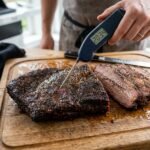
Knowing how to read a meat thermometer properly makes a huge difference here. Insert the probe into the thickest part of the meat, away from the bone. If your shoulder is bone-in, the bone conducts heat differently and can give you a false reading if the probe is too close.
Quick Fact: The USDA says pork is safe at 145°F. But “safe to eat” and “ideal for pulled pork” are two completely different things. At 145, pork shoulder would be tough and chewy. You need those extra 50+ degrees to transform the texture.
The Stall — And Why Your Pork Shoulder Seems Stuck
If you’ve never smoked a large cut of meat before, the stall will test your patience like nothing else. Here’s what happens.
Your pork shoulder goes on the smoker, the internal temperature climbs steadily for the first few hours — 100°F, 120°F, 140°F, 155°F — and then somewhere between 150°F and 170°F, the temperature just… stops. For hours. Sometimes it even drops a degree or two. You’ll start questioning your smoker, your thermometer, your life choices.
This is completely normal. The stall happens because moisture inside the meat starts evaporating from the surface, and that evaporation cools the meat at the same rate the smoker is heating it. It’s the exact same principle as sweating — your body sweats to cool down, and the pork shoulder is doing the same thing.
At 275°F, the stall is typically shorter than at 225°F, but it still happens. Expect it to last anywhere from 1 to 3 hours. Some people see a stall that barely lasts 45 minutes at 275; others hit one that drags on for 2+ hours. Again — every piece of meat is different.
You have two options: ride it out, or wrap.
To Wrap Or Not To Wrap — Making The Call
This is one of the most debated topics in BBQ, right up there with whether you should boil ribs before grilling (you shouldn’t, by the way). Let’s break down both approaches.
Going Unwrapped The Entire Cook
If you don’t wrap, you’ll develop a thicker, crunchier bark. The smoke has continuous access to the meat surface, so you get a deeper smoke flavor and that dark mahogany color that looks incredible. The trade-off? Your cook takes longer because the stall plays out fully. You’ll also lose slightly more moisture through evaporation — though with a fatty cut like pork shoulder, this is rarely a problem.
Wrapping During The Stall (The Texas Crutch)
When internal temp hits around 160°F to 165°F, you can wrap the shoulder tightly in either foil or butcher paper. This traps moisture and heat, pushes through the stall faster, and keeps the meat juicier. The downside is your bark softens because the steam has nowhere to escape.
If you wrap in foil, the bark gets quite soft — almost steamed. If you use butcher paper instead of parchment paper, you get a nice middle ground. Butcher paper is porous enough to let some moisture escape while still accelerating the cook. It’s what most BBQ restaurants use, and there’s a good reason for that.
My personal approach? I go unwrapped until 165°F to let the bark set, then wrap in unlined butcher paper for the rest of the cook. At 275°F, this typically saves me about 90 minutes compared to going naked the whole time, and the bark stays plenty good.
Warning: If you wrap in foil and then leave it too long, you can end up with mushy, pot-roast-like texture. Watch your temperature closely after wrapping — things move fast.
Step-By-Step: Smoking Pork Shoulder At 275°F
Alright, let’s put it all together into a practical game plan.
Prep The Night Before
Take your pork shoulder out of the packaging and pat it dry with paper towels. Trim any loose flaps of meat or excessive fat — you want to leave about a ¼-inch fat cap, not remove it entirely. That fat renders during the cook and keeps everything moist.
Apply your rub generously. For pork shoulder, you don’t need anything fancy. A solid base of equal parts brown sugar, paprika, garlic powder, onion powder, salt, and black pepper works beautifully. Mustard-based rubs are popular too. Apply the rub the night before and let the shoulder sit uncovered in the fridge. This does two things: the salt penetrates deeper into the meat, and the surface dries out slightly, which helps bark formation.
Getting The Smoker Ready
Fire up your smoker and stabilize it at 275°F. Whether you’re using a pellet smoker (like a Pit Boss — here’s a settings guide if you need it), an offset, a Weber Smoky Mountain, or a kamado, the principle is the same: stable temperature is more important than exact temperature. If your smoker fluctuates between 265 and 285, that’s totally fine. Wild swings from 250 to 300 every few minutes? That’s a problem.
For wood, fruit woods like apple and cherry pair beautifully with pork. They give a sweet, mild smoke that complements rather than overpowers. Hickory works great too if you want a stronger smoke flavor — it’s probably the most popular choice for pork shoulder. If you’re curious about wood differences, the comparison between hickory and mesquite is worth understanding. Mesquite can be too aggressive for a long cook like pork shoulder.
The Cook Itself
Place the shoulder fat-cap up on the grate. Some pitmasters argue fat-cap down to protect the meat from the heat source — and honestly, both work. Fat-cap up lets the rendering fat baste the meat as it melts, which I slightly prefer.
For the first 3 to 4 hours, leave the smoker closed. Resist the urge to peek. Every time you open the lid, you lose heat and extend your cook time. The meat is absorbing the most smoke during these early hours when the surface is still cool and moist.
Around hour 4 or 5 (usually when internal temp hits 150-160°F), you’ll enter the stall zone. This is your decision point for wrapping.
If you wrap, do it at 160-165°F. Use a good instant-read thermometer to check — probe several spots, because large cuts can have significant temperature variation from one end to the other.
After wrapping (or choosing not to), let the smoker do its job. At 275°F, you should see the temperature climb steadily again after the stall breaks, typically moving about 3-5 degrees per hour in the 170-195°F range, then slowing down as you approach 200°F.
Knowing When It’s Done
Internal temperature should read 195°F to 205°F in the thickest part. But here’s a test that’s even better than temperature: the probe test. Stick your thermometer probe or a toothpick into the meat. It should slide in with almost zero resistance — like poking warm butter. If there’s any tightness or resistance, give it another 30 minutes regardless of what the temperature reads.
This is similar to how pitmasters know when to pull brisket — temperature gets you in the ballpark, but feel and probe tenderness tell the real story.
The Rest Period — Don’t Skip This
I know it’s tempting. Your pork shoulder is done, it smells unbelievable, and you want to pull it right now. But resting is not optional if you want the best results.
When you rest meat, the muscle fibers relax and reabsorb some of the juices that were pushed toward the surface during cooking. If you cut or pull immediately, those juices run out onto the cutting board instead of staying in the meat.
For pork shoulder, rest for at least 30 minutes, and ideally 45 to 60 minutes. Here’s how to do it properly: if the shoulder is wrapped, leave it wrapped. Place it in a dry cooler (no ice) and close the lid. The insulation will keep it above 140°F for hours — I’ve had shoulders hold above 160°F for over 3 hours in a cooler.
This is actually a great trick if your shoulder finishes early. Just park it in the cooler and it’ll stay hot and ready until your guests arrive.
Did You Know? A well-insulated cooler can hold a wrapped pork shoulder at safe serving temperatures (above 140°F) for up to 4 hours. Some competition teams cook their shoulders the night before and hold them in coolers until judging.
Bone-In vs. Boneless — Does It Change Cook Time?
Yes, but not as much as you’d think.
A bone-in pork shoulder (Boston butt) actually cooks slightly differently because the bone conducts heat into the center of the meat. Some pitmasters swear bone-in cooks a touch faster for this reason. Others say the bone insulates the surrounding meat and slows things down. In reality, the difference is maybe 15 to 30 minutes on an 8-pound cut. Not worth stressing over.
The real advantage of bone-in is the flavor. Bones add richness to the meat around them, and when the shoulder is fully done, the bone will slide out cleanly with almost no effort. That’s actually another doneness indicator — if the bone won’t budge, the meat needs more time.
Boneless shoulders are easier to wrap and more uniform in shape, which can mean more even cooking. They also tend to shred a bit more completely since there’s no bone in the way. If you’re feeding a big crowd and want maximum pulled pork yield, boneless is slightly more efficient.
For understanding pulled pork internal temp targets more deeply, the target stays the same regardless of bone-in or boneless — 195 to 205°F.
275°F vs. 225°F — A Realistic Comparison
I’m not going to tell you one is “better” than the other, because that depends on what you’re optimizing for. But here’s an honest comparison so you can decide.
At 225°F, an 8-pound shoulder takes roughly 12 to 16 hours. The smoke penetration is deeper because the meat spends more time at lower temperatures when the surface is most receptive to smoke. The stall lasts longer. The bark is good but sometimes a bit softer unless conditions are perfect. And you’re basically committing an entire overnight or full day to the cook.
At 275°F, that same shoulder takes 8 to 10.5 hours. Still a long cook, but much more manageable for a same-day cook. The bark tends to be slightly thicker and crispier. Smoke ring depth is slightly less, but still very visible. And in a blind taste test? Most people can’t tell the difference.
If you’ve smoked brisket before — say, smoking brisket at 225 — you already know how long those low-temp cooks can be. Pork shoulder at 275 gives you similar quality with a lot less time commitment.
The 275 approach is especially great if you don’t want to babysit a smoker overnight. Start at 6 or 7 AM, and you’ll have pulled pork ready for a 5 or 6 PM dinner. That’s a reasonable timeline that doesn’t require setting an alarm at 3 AM.
Spraying, Mopping, and Basting — Worth It?
A lot of recipes call for spraying or mopping the pork shoulder every 45 minutes to an hour with apple cider vinegar, apple juice, or a mix of both. Does it actually make a difference?
Honestly, the moisture impact is minimal. The spray doesn’t penetrate into the meat — it’s a surface-level thing. What it does do is keep the surface moist, which helps smoke adhere better and can contribute to bark development. The sugars in apple juice also help with browning.
If you’re cooking unwrapped the whole time, spraying every hour after the first 3 hours is a reasonable move. If you’re planning to wrap at 165°F, it matters less because the wrap itself locks in plenty of moisture.
The one downside of frequent spraying? You’re opening the smoker each time. At 275°F, you lose about 10-15 degrees every time you lift the lid, and it takes a few minutes to recover. So if you’re going to spray, do it quickly — lid up, spray, lid down, done in 10 seconds.
I usually spray twice during the cook — once around hour 3, once right before wrapping. That’s it. My pulled pork turns out plenty moist.
What To Do If Your Pork Shoulder Finishes Early (Or Late)
Finishes Early
This happens more often than you’d expect, especially with smaller shoulders or particularly fatty cuts. If your shoulder hits 203°F and probes like butter two hours before dinner — no worries at all. Wrap it in foil (if it isn’t already), then wrap the whole thing in old towels, and place it in a cooler. Like I mentioned earlier, it’ll stay hot for hours.
Finishes Late
This is more stressful, especially with hungry guests. If you’re running behind, you have a couple options. You can bump your smoker temperature to 300°F for the last stretch. At this point, the bark is already set and you’re not going to damage it. You’ve already absorbed all the smoke the meat is going to take. The higher heat will just push through the last few degrees faster.
Another option is to finish in the oven at 300°F. I know, I know — it feels like cheating. But the reality is, once the meat is wrapped and past 170°F internal, it’s not getting any more smoke flavor. The oven is just a heat box at that point, and it’s more efficient and stable than most smokers.
Troubleshooting Common Problems
Bark is too dark or bitter: Your smoker might be running hot, or you’re using too much wood. At 275°F, you need less smoke wood than at 225 because the higher heat combusts the wood faster. Use 2-3 chunks instead of 4-5, and make sure you’re getting clean, thin blue smoke — not thick white billowing smoke.
Meat is done but won’t pull apart: You probably pulled it too early. Even if the thermometer says 200°F, check the probe feel. If there’s resistance, put it back on for another 30-45 minutes. Temperature is a guide, not a guarantee.
Pork is mushy, not pull-apart: This usually means it was wrapped in foil too early or left wrapped at high heat for too long. The texture goes from “tender” to “mushy” if collagen over-converts. It’s a narrow window, but the fix for next time is to monitor more closely once you pass 195°F.
Bark is soft or nonexistent: This usually comes from wrapping too early (before the bark has set) or from too much moisture in the smoker. Make sure the bark feels dry and firm to the touch before wrapping. If you touch it and your finger comes away wet, give it more time.
Quick Tips From Years Of Smoking Pork Shoulder
A clean-burning fire matters more than the type of smoker you use. Get your fire right and even a cheap offset will produce great pork.
Don’t sauce the meat while it’s on the smoker unless you want a sticky mess. Sauce after pulling — or better yet, let people sauce their own portions.
If you’re cooking for a crowd, plan for about ⅓ pound of finished pulled pork per person. An 8-pound raw shoulder yields roughly 5 pounds of pulled pork after trimming, bone, and moisture loss. That feeds about 12-15 people for sandwiches.
And the most important tip? Start earlier than you think you need to. A shoulder that finishes 2 hours early and rests in a cooler will be better than one you rush to finish. Time is your friend with this cut — the longer it rests, the more tender it gets, up to about 3-4 hours.
FAQ
Can I smoke pork shoulder at 275 on a pellet grill?
Absolutely. Pellet grills are actually great for this because they maintain temperature very consistently. Set it to 275°F and let the controller do its thing. If you’re using a Pit Boss, check out the P-setting guide to fine-tune your smoke output. One thing to note — pellet grills tend to produce lighter smoke flavor than stick burners, so don’t expect an overpowering smoke ring. The flavor will still be excellent.
Is 275°F too hot for pulled pork?
Not at all. Pork shoulder is extremely forgiving because of its high fat and collagen content. Many award-winning BBQ restaurants smoke pork at 275°F to 300°F daily. The key is reaching the right internal temperature (195-205°F) regardless of what temperature the smoker is set at. You’d need to go well above 325°F before you’d start risking dried-out pork shoulder.
How do I know when pork shoulder is done without a thermometer?
It’s tough, but possible. Look for these signs: the bone (if bone-in) wiggles freely and pulls out clean. The meat jiggles slightly when you shake the grate. The bark has darkened to a deep brown or near-black color. And if you poke it with a fork or skewer, it should slide in with no resistance whatsoever. That said, I’d strongly recommend getting a good instant-read thermometer — it takes the guesswork out entirely. Here’s a helpful guide on how to read a meat thermometer if you’re unsure about proper technique.
Should I put pork shoulder fat side up or down at 275°F?
Both work. Fat side up lets rendering fat drip down through the meat, adding moisture. Fat side down uses the fat cap as a heat shield between the meat and the fire — which matters more in offset smokers where the heat comes from below. At 275°F, I prefer fat side up because the slightly higher heat renders the cap more efficiently, and I like the basting effect. Try both on your next two cooks and see which you prefer — the difference is subtle.
Can I smoke a frozen pork shoulder at 275°F?
Don’t. A frozen shoulder will spend too long in the 40°F to 140°F “danger zone” where bacteria multiply rapidly. Always thaw fully in the refrigerator first — a large shoulder can take 24 to 48 hours to thaw completely. Plan ahead.
Your Next Pork Shoulder Is Going To Be Great
Smoking pork shoulder at 275°F is one of the most reliable ways to get incredible pulled pork without turning it into an overnight marathon. You’re looking at about 60 to 80 minutes per pound, a target internal temp of 203°F, and a mandatory rest period that turns good pork into great pork.
The beauty of this cut is how forgiving it is. Even if your temperature fluctuates, even if you wrap a little early or a little late, even if you guess wrong on the timing — pork shoulder almost always turns out delicious. It’s the best cut for beginners to practice on and one that experts never get bored of perfecting.
So fire up the smoker, keep your thermometer close, and trust the process. Once you smell that bark forming at hour three, you’ll know exactly why people love this hobby.