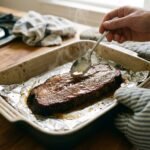
A 12-pound packer brisket can take anywhere from 14 to 18 hours at 225°F. That’s not a typo — we’re talking about nearly an entire day of cooking. And if you’ve never done it before, that number alone can feel overwhelming.
But here’s the thing. Smoking brisket at 225 degrees isn’t just about patience. It’s about understanding why this temperature works, what happens to the meat during those long hours, and how to avoid the mistakes that turn a beautiful piece of beef into a dried-out disappointment.
Whether you’re firing up an offset smoker, a pellet grill like a Pit Boss or Traeger, or even a Weber kettle, this guide breaks down the real timing you need, what affects it, and how to get that tender, melt-in-your-mouth result every single time.
Why 225°F Is the Sweet Spot for Brisket
You might wonder — why specifically 225°F? Why not 250 or 300?
The answer lies in what brisket actually is. Brisket comes from the chest area of the cow — it’s a heavily worked muscle loaded with collagen and connective tissue. If you want to know more about the anatomy, check out this guide on what part of the cow brisket comes from. All that tough connective tissue needs time and gentle heat to break down into gelatin. That’s what gives properly smoked brisket its juicy, almost buttery texture.
At 225°F, the collagen breakdown happens slowly and evenly. The fat renders without the meat seizing up. Smoke has time to penetrate deep into the bark. It’s a balance — hot enough to cook safely, cool enough to not rush the process.
Push the temperature too high, and you risk the outside drying out before the inside has had time to properly render. Go too low, and you’re in the danger zone where bacteria can grow. 225°F threads the needle perfectly.
That said, 225 isn’t the only good temperature. Many pitmasters run their smokers at 250°F for a slightly faster cook without sacrificing quality. If you want to compare options, you can read about the best temperature to smoke brisket to find what fits your setup.
How Long to Smoke Brisket at 225 Per Pound
The general rule most pitmasters follow: plan for 1 to 1.5 hours per pound at 225°F.
So for a typical packer brisket — which usually weighs between 12 and 16 pounds — you’re looking at roughly 12 to 24 hours of total cook time. That’s a wide range, and for good reason. Every brisket is different. The grade of beef, the fat cap thickness, the specific shape of your cut — all of these affect timing.
Here’s a realistic breakdown based on weight:
8-pound brisket (usually a flat): 10–14 hours
10-pound brisket: 12–16 hours
12-pound packer brisket: 14–18 hours
14-pound packer brisket: 16–20 hours
16-pound packer brisket: 18–24 hours
These are estimates. Your actual cook could run shorter or longer depending on factors we’ll cover below. The most important thing to remember? Cook to internal temperature, not to time. A clock gives you a rough plan. A thermometer gives you the truth.
If you’re not sure how to use one properly, this guide on how to read a meat thermometer can help you get accurate readings every time.
The Stall — That Frustrating Phase Every Brisket Goes Through
Here’s what catches most first-timers off guard. You’ve been smoking your brisket for 4 or 5 hours. The internal temperature has been climbing steadily — 120°F, 140°F, 155°F. And then… it just stops. For hours.
You check the thermometer again. Still 155°F. You check your smoker temperature — it’s holding steady at 225°F. Nothing seems wrong, but the meat just won’t budge.
This is called the stall, and it happens to every brisket. It’s not a sign that something went wrong. It’s actually a sign that something is going right.
What Causes the Stall?
The stall happens because of evaporative cooling. As the brisket cooks, moisture from inside the meat rises to the surface and evaporates. That evaporation has a cooling effect — similar to how sweating cools your body. The cooling effect becomes strong enough to counterbalance the heat from the smoker, so the internal temperature plateaus.
The stall typically kicks in somewhere between 150°F and 170°F and can last anywhere from 2 to 6 hours. Yes, six hours of watching your thermometer do absolutely nothing. It takes real discipline to not panic.
How to Push Through the Stall
You have two choices here, and both work.
Option 1: Ride it out. Just let the brisket do its thing. The stall will eventually break as the surface dries out and the cooling effect diminishes. This gives you a thicker, crustier bark, but it adds significant time to your cook.
Option 2: Wrap the brisket. Most competition pitmasters and backyard pros use this approach — often called the “Texas Crutch.” When your brisket hits the stall zone (around 160–170°F), you wrap it tightly in either butcher paper or aluminum foil. This traps moisture, kills the evaporative cooling effect, and pushes the temperature past the stall much faster.
There are real differences between the two wrapping materials. Butcher paper is breathable, so it preserves more bark texture while still speeding things up. Foil creates a tighter seal and pushes through the stall faster, but can soften the bark. If you’re deciding between them, this comparison of butcher paper vs parchment paper for smoking clears things up nicely.
Knowing exactly when to wrap your brisket makes a big difference in the final result, so it’s worth dialing in that timing.
What Internal Temperature Should You Pull Brisket?
Here’s where people get tripped up. You’ll hear “cook to 195°F” or “cook to 203°F” thrown around like gospel. But the real answer is a bit more nuanced.
The target range for pulling brisket off the smoker is 200°F to 210°F internal temperature. Most briskets hit their perfect tenderness window right around 202–205°F. But that number alone doesn’t tell the whole story.
The Probe Test Matters More Than the Number
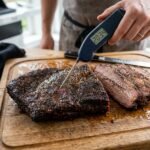
The best way to know your brisket is truly done? The probe test. Slide a thermometer probe or a toothpick into the thickest part of the flat and the point. If it goes in with almost no resistance — like sliding into room-temperature butter — your brisket is done. If there’s still some pushback, give it more time regardless of what the temperature reads.
Some briskets hit perfection at 198°F. Others need to reach 208°F before the connective tissue fully renders. The variation depends on the specific cut, the marbling, and how the cook went up to that point.
For a deeper look at why 210°F is often the target internal temperature, and when to aim for slightly higher or lower, that guide has you covered.
And if you’re wondering about the best spot to place your probe, knowing where to probe brisket ensures you’re getting an accurate read and not just measuring a fat pocket.
Flat vs. Packer Brisket — Timing Differences
Not all briskets are the same size or shape, and the cut you’re working with dramatically changes your cook time.
A brisket flat is the leaner, thinner portion. It usually weighs between 5 and 8 pounds. Because it’s thinner and has less intramuscular fat, it cooks faster — typically 8 to 14 hours at 225°F. But it’s also more prone to drying out, so you need to watch it more carefully.
A full packer brisket includes both the flat and the point, connected by a fat seam. Packers typically weigh 12 to 18 pounds and take 14 to 24 hours at 225°F. The point section has more marbling and fat, which gives it more forgiveness during the cook.
If you’re trying to decide which to buy, here’s a straightforward comparison of brisket flat vs packer that can help.
Pro Tip: If you’re new to smoking brisket, start with a full packer. I know that sounds counterintuitive — it’s bigger and takes longer. But the extra fat content makes it much more forgiving. A lean flat punishes mistakes. A packer brisket gives you a cushion.
Factors That Affect How Long Your Brisket Takes
Even with the 1–1.5 hours per pound guideline, your actual cook time can swing wildly. Here’s what influences it.
1. Meat Thickness (Not Just Weight)
A long, thin 12-pound brisket will cook faster than a short, thick 12-pound brisket. Heat penetrates from the outside in, so thickness matters more than total weight. Two briskets with the same weight can have very different cook times based on their shape.
2. Smoker Type and Airflow
An offset smoker with good airflow cooks differently than a tightly insulated pellet grill. Offsets can have hot spots and temperature fluctuations, which may extend your cook time. Pellet grills like a Pit Boss hold temperature more consistently. If you’re using a Pit Boss, understanding the P setting on your grill helps you maintain that rock-solid 225°F.
3. Outside Weather
Smoking in January in Minnesota is a completely different experience than smoking in July in Texas. Cold, windy weather pulls heat away from your smoker, making it work harder to maintain temperature. A 15-pound brisket that takes 18 hours in summer might take 20+ hours in winter.
4. How Often You Open the Lid
Every time you lift that lid, you lose heat. It can take your smoker 15–20 minutes to recover back to 225°F after being opened. If you’re checking every 30 minutes because you’re nervous, you could add hours to your cook. Trust the process. Check only when you need to — to spritz, to wrap, or to probe.
5. Meat Grade and Marbling
A USDA Prime brisket has more marbling than Choice or Select. That fat takes time to render, which can slightly extend the cook. But it also makes the end result significantly more tender and flavorful. If you’re curious about whether the price difference is worth it, here’s a breakdown of prime vs choice brisket.
Step-by-Step: Smoking a Brisket at 225°F
Let me walk you through the actual process from start to finish.
The Night Before
Take your brisket out of the packaging and trim the fat cap down to about ¼ inch thickness. You want enough fat to protect the meat during the cook, but not so much that smoke and seasoning can’t penetrate. Remove any hard chunks of fat that won’t render.
Apply your rub — a classic Texas-style rub is just coarse black pepper and kosher salt in equal parts. Simple, but it works beautifully. Let the brisket sit uncovered in the fridge overnight. This helps the rub adhere and dries the surface, which promotes better bark formation.
Morning — Getting the Smoker Ready
Fire up your smoker and stabilize it at 225°F. This is important — don’t put the brisket on until your smoker has held steady at 225 for at least 15–20 minutes. Load your wood — post oak is the classic choice for brisket, but hickory works great too. If you’re debating wood choices, this comparison of hickory vs mesquite is worth a read.
On the Smoker — Hours 1 Through 4
Place the brisket fat-side up (or down, depending on your smoker setup — more on that in a second) and close the lid. For the first few hours, just leave it alone. Smoke is doing its work, bark is forming, and the internal temperature will climb steadily.
Some people spritz with apple cider vinegar or beef broth every hour after the first 2–3 hours. This adds moisture to the surface and can help with bark development. Don’t overdo it though — a light mist is enough.
Hours 5 Through 8 — The Stall Zone
This is where the stall typically hits. Your internal temp might hover around 155–170°F for what feels like forever. Stay calm. If you plan to wrap, now’s the time to monitor closely. Once you see the bark has set and the color is a deep mahogany, wrap the brisket and return it to the smoker.
Hours 9 Through Finish — The Home Stretch
After wrapping, the temperature should climb more steadily. You’re heading toward that 200–205°F target. Start probe-testing around 195°F. Remember — you’re feeling for that butter-soft resistance, not just watching a number.
The Rest — Don’t Skip This
When your brisket probes tender, pull it off the smoker. But don’t slice it yet. Resting is non-negotiable.
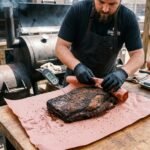
Wrap it in a towel (if it’s in butcher paper or foil already, just add the towel on top) and place it in a cooler with no ice. Let it rest for a minimum of 1 hour — but 2 to 4 hours is even better. During the rest, the internal temperature will drop slowly while the juices redistribute throughout the meat. Cut too early, and those juices run out onto your cutting board instead of staying in the brisket.
Knowing when to pull your brisket off the smoker — and then giving it a proper rest — is honestly the difference between good brisket and great brisket.
How Much Brisket Do You Need?
Before you commit to a 20-hour cook, make sure you’re buying the right amount. A raw brisket loses about 40–50% of its weight during cooking due to fat rendering and moisture loss. So a 14-pound raw packer will yield roughly 7–8 pounds of cooked meat.
For serving sizes, plan on about ½ pound of cooked brisket per person — more if your guests are big eaters or you want leftovers. If you need a detailed breakdown, check out this brisket per person guide so you don’t end up short.
And if you do end up with leftovers (lucky you), knowing how to reheat brisket without drying it out will save your next-day meal.
Should You Brine Brisket Before Smoking?
This comes up a lot, and opinions are split. A wet brine or dry brine can add moisture and seasoning deep into the meat, which is especially helpful for leaner flat cuts. For a full packer with plenty of marbling, a simple overnight dry rub might be all you need.
If you’re considering it, here’s a full look at whether you should brine brisket and when it actually makes a difference.
Slicing Your Brisket the Right Way
You’ve waited 16+ hours for this moment. Don’t rush the final step.
Always slice brisket against the grain. The grain direction changes between the flat and the point, so pay attention as you work through the cut. Slicing with the grain gives you stringy, chewy pieces. Slicing against it gives you tender slices that practically fall apart.
Use a long, sharp slicing knife. Cut the flat into pencil-width slices — about ¼ inch thick. The point can be sliced thicker or cubed into burnt ends.
For a visual walkthrough and more detail, this guide on how to slice brisket walks you through the whole process.
FAQ
How long does a 10-pound brisket take at 225°F?
A 10-pound brisket will typically take 12 to 16 hours at 225°F. The stall phase alone can add 2 to 4 hours to your total cook time. Always use an internal thermometer and the probe test to determine doneness rather than relying solely on time.
Can I smoke brisket at 225 overnight?
Absolutely. Many pitmasters start their briskets late at night so they’re ready by the next afternoon or evening. If you’re using a pellet grill with good temperature control, an overnight cook at 225°F works perfectly. Just make sure your hopper has enough pellets and set an alarm to check around the time you expect the stall to hit.
Is 225 or 250 better for brisket?
Both temperatures produce excellent brisket. 225°F gives you a slightly longer cook with more smoke exposure and potentially deeper flavor. 250°F reduces the total cook time by a couple of hours without noticeably sacrificing quality. Many experienced smokers run at 225 for the first half and bump to 250 after wrapping. Either way, the end result depends more on hitting the right internal temperature and resting properly.
How do I know when my brisket is done?
The best indicator is a combination of internal temperature and probe feel. When the thickest part of the brisket reads between 200°F and 210°F, start testing with a probe. It should slide in with zero resistance — like poking a warm stick of butter. If it still feels tight, give it another 30 minutes and test again.
What if my brisket is done too early?
This happens more often than people think, especially if you started cooking the night before and the brisket finishes ahead of your meal time. Don’t panic. Wrap the brisket tightly, wrap it again in old towels, and place it in a cooler. A well-wrapped brisket can hold at safe serving temperature for 4 to 6 hours in a cooler. Some competition teams hold brisket for even longer. It’ll still be tender and juicy when you finally slice.
Your Brisket Is Worth the Wait
Smoking brisket at 225°F is a commitment. There’s no getting around the 12 to 20+ hours it demands. But every pitmaster who’s pulled a perfectly tender, smoky brisket off the grill after a long cook will tell you — there’s nothing else quite like it.
Stick to the fundamentals. Trim well, season simply, maintain your temperature, wrap when the stall hits, and trust your thermometer over your clock. Give it a proper rest. Slice against the grain.
And next time someone asks you how long to smoke brisket at 225? You’ll know it’s not just about the hours. It’s about understanding what’s happening inside that meat every step of the way.
Now go light that smoker.