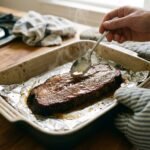
A 14-pound packer brisket. Twelve hours of smoke. Perfectly maintained fire all night. And then — you pull it off 30 minutes too early, and the flat turns out dry and chewy. All that effort, gone.
That’s the cruel reality of brisket. You can do everything right for hours and still mess it up in the final stretch if you don’t know exactly when to pull it off the smoker. The tricky part? There’s no single magic number that works every time. Your brisket’s size, the fat content, your smoker type, and even the weather outside — all of these play a role.
So how do you know when your brisket is truly done? That’s exactly what we’re going to break down here. Not just temperature readings, but the feel, the look, the probe test, and the small details that separate a good brisket from a legendary one.
Why Pulling at the Right Time Matters So Much
Brisket isn’t like grilling a steak where a few degrees don’t make a huge difference. Brisket is a tough cut — it comes from the chest of the cow, and it’s loaded with connective tissue and collagen. That collagen needs time and heat to break down into gelatin, which is what gives properly smoked brisket that buttery, melt-in-your-mouth texture.
Pull it too early, and that collagen hasn’t fully rendered. You’ll end up with meat that’s technically “cooked” but still tough and hard to chew. Pull it too late, and the muscle fibers have squeezed out too much moisture. The result? Dry, crumbly meat that falls apart — but not in the good way.
There’s a sweet spot, and finding it is part science, part feel. If you’ve ever wondered what part of the cow brisket actually comes from, understanding the muscle structure helps you appreciate why timing matters this much.
The Internal Temperature Sweet Spot
Let’s start with the most concrete answer: internal temperature. Most pitmasters agree that brisket is done somewhere between 195°F and 205°F (90–96°C). But here’s the thing — that’s a 10-degree range, and where YOUR brisket falls within that range depends on several factors.
Why 195°F to 205°F?
Collagen in beef starts breaking down around 160°F, but it really accelerates between 180°F and 200°F. By the time you hit 195°F, most of the collagen has converted to gelatin. The meat is tender, juicy, and holds together while still being easy to slice.
Some briskets are done at 195°F. Others need to hit 203°F or even 205°F before they feel right. Aaron Franklin — arguably the most famous pitmaster in the world — has said he typically pulls his briskets around 203°F, but he also emphasizes that temperature alone doesn’t tell the whole story.
The Flat vs. The Point
Here’s something a lot of people overlook. Brisket has two distinct muscles — the flat and the point. The flat is leaner, and the point has more intramuscular fat. They cook differently.
The flat often reaches temperature faster and can dry out if you’re waiting for the point to catch up. That’s why knowing the difference between a brisket flat and a full packer matters when you’re deciding your pull time.
If you’re cooking a flat-only brisket, you might pull it closer to 195–200°F. A full packer with a thick point? You might let it ride up to 203–205°F because the point’s extra fat keeps it moist.
Pro Tip: Always insert your thermometer probe into the thickest part of the flat — that’s the leanest section and the part most at risk of drying out. If the flat is done, the point is almost certainly done too. For guidance on exact probe placement, check out this guide on where to probe brisket.
The Probe Test — Your Most Reliable Tool
Here’s a truth that experienced pitmasters will tell you: temperature gets you close, but the probe test tells you when you’re actually there.
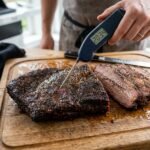
What’s the probe test? Simple. Take a thermometer probe, a skewer, or even a toothpick and slide it into the thickest part of the brisket. If it slides in with almost no resistance — like pushing into warm butter or a jar of peanut butter — your brisket is done.
If there’s any tug, any resistance, any feeling of the probe “catching” on something inside the meat, it’s not ready. Give it more time.
Why the Probe Test Works Better Than Temperature Alone
Two briskets of the same weight, cooked at the same temperature, on the same smoker, can finish at different internal temps. One might probe tender at 197°F. The other might still feel firm at 200°F and only soften up at 204°F.
Why? Because every piece of meat is different. The amount of collagen, the fat marbling, the age of the animal, whether you chose prime or choice grade — all these variables affect how long the collagen takes to fully break down.
So use your thermometer to know when to START checking. Once you hit 195°F, begin probing every 15–20 minutes. When it feels like butter, that’s your moment.
The Jiggle Test and Visual Cues
Beyond temperature and the probe test, there are visual and tactile cues that experienced pitmasters rely on.
The Jiggle
Pick up the brisket with gloved hands or use tongs to gently shake it. A properly done brisket will jiggle and wobble like Jell-O. The whole thing should feel loose and floppy. If it feels stiff or holds its shape rigidly, it needs more time.
This jiggle happens because the internal collagen has turned to gelatin, and the fat has fully rendered. The muscle fibers are relaxed and surrounded by liquid goodness. That’s exactly what you want.
Bark Appearance
The bark — that dark, crusty exterior — should be deeply colored, almost black in spots, but not burnt. It should look dry to the touch but feel slightly tacky if you press it gently. If the bark still looks wet or the rub hasn’t set properly, your brisket probably isn’t there yet.
Bend Test
If you pick up the brisket from the middle with tongs, it should bend dramatically. The two ends should droop down heavily. Some people call this the “horseshoe” shape. A brisket that holds straight or only bends slightly still has work to do.
Does the “Stall” Affect When You Pull?
If you’ve smoked brisket before, you know about the stall. It’s that frustrating period — usually between 150°F and 170°F — where the internal temperature just stops climbing. Sometimes for hours.
The stall happens because of evaporative cooling. Moisture on the meat’s surface evaporates, cooling the brisket at roughly the same rate the smoker heats it. It’s like how sweating keeps your body cool on a hot day.
The stall doesn’t change WHEN you should pull the brisket (you’re still aiming for that 195–205°F probe-tender zone), but it does affect HOW LONG it takes to get there.
Wrapping to Push Through
Many pitmasters wrap their brisket in butcher paper or aluminum foil once it hits around 165–170°F. This is often called the “Texas Crutch.” Wrapping traps moisture, stops the evaporative cooling, and pushes the brisket through the stall faster.
If you’re wondering about the ideal time to wrap, this brisket wrap temperature guide goes into more detail. And if you’re debating between wrapping materials, butcher paper vs. parchment paper is worth reading — they behave very differently on a smoker.
Quick Fact: Wrapping in foil can speed up cook time by 1–2 hours compared to going unwrapped (“naked”). But foil can soften your bark. Butcher paper is a middle ground — it speeds things up while still letting the bark breathe.
How Your Smoker Temperature Affects Pull Time
The temperature you run your smoker at doesn’t change the internal temp you’re aiming for, but it dramatically affects how long it takes to get there — and how forgiving the process is.
Low and Slow at 225°F
This is the classic approach. Running your smoker at 225°F gives you maximum smoke flavor and a very gradual collagen breakdown. The downside? A full packer brisket can take 12–18 hours. The upside? The slower cook gives collagen more time to render, and you have a bigger window before the meat goes from “done” to “overdone.”
If you want a detailed breakdown of this approach, here’s a full guide on smoking brisket at 225°F.
Hot and Fast at 275°F+
Some pitmasters run their smokers at 275°F or even 300°F. This cuts cook time significantly — sometimes down to 8–10 hours for a full packer. But the window between “perfectly done” and “overdone” gets tighter. You need to be more vigilant with your temperature monitoring.
At higher smoker temps, the exterior cooks faster than the interior, so wrapping becomes almost essential to prevent the outer layers from drying out before the center finishes.
What About 250°F?
Think of 250°F as the sweet spot most backyard smokers hit naturally. You get reasonable cook times and good bark development without rushing the collagen breakdown. For most beginners, this is the temperature to start with.
No matter what temp you run, the PULL temperature stays the same: probe tender, somewhere between 195°F and 205°F. To understand the best smoker temperature for your setup, this guide on the best temp to smoke brisket breaks it all down.
The Carryover Effect — Why You Might Pull Earlier Than You Think
Here’s something that catches a lot of first-timers off guard: carryover cooking. When you pull your brisket off the smoker, it doesn’t stop cooking immediately. The residual heat in the outer layers continues traveling inward, and the internal temperature can rise another 5–10°F after you remove it from the smoker.
So if your brisket probes butter-soft at 200°F, and you leave it on the smoker until it hits 205°F, it might actually coast up to 210–215°F during the rest. That could push it past the ideal zone and dry out the flat.
Experienced pitmasters account for this. If your brisket is probing tender at 200°F, that’s often the right time to pull — especially if you’re planning a long rest.
Warning: Carryover is more significant with larger briskets (15+ pounds) and when you’ve been cooking at higher temperatures. A small flat cooked at 225°F won’t carry over as much as a full 18-pound packer cooked at 275°F.
The Rest — What Happens After You Pull
Pulling the brisket off the smoker is only half the equation. What you do AFTER pulling is just as critical.
Why Resting Matters
When brisket cooks, the muscle fibers tighten and push moisture toward the center. If you slice into the brisket right away, all that moisture runs out onto your cutting board instead of staying in the meat.
Resting allows the fibers to relax and reabsorb that moisture. The result? Juicier slices with better texture.
How Long to Rest
The minimum rest time is about 1 hour. But most competition pitmasters and BBQ restaurants rest their briskets for 2–4 hours, and some hold them for up to 6–8 hours in a faux cambro (a cooler lined with towels).
Here’s a simple resting method that works great at home:
Wrap the brisket tightly in butcher paper (if it isn’t already), then wrap it in an old towel. Place it in a cooler — no ice, just the dry cooler. Close the lid. The insulated environment will keep the brisket at a safe serving temperature (above 140°F) for hours while it continues to tenderize and redistribute moisture.
Don’t Skip This Step
Seriously, don’t. Even if your family is hungry and the brisket smells incredible. Cutting too early can undo hours of careful smoking. A properly rested brisket is noticeably juicier than one sliced fresh off the smoker. It’s the difference between “good” and “people-asking-for-your-recipe.”
When the time comes to slice, technique matters too — here’s how to slice brisket properly so you’re cutting against the grain for maximum tenderness.
Signs Your Brisket Was Pulled Too Early
Even with the best intentions, sometimes you pull the trigger too soon. Here’s how to tell:
The flat is tough and chewy, even though it looked great on the outside. The connective tissue hasn’t broken down, and you can see distinct, stringy muscle fibers that resist your teeth. The slices hold together TOO well — almost like you’re cutting roast beef rather than brisket. And the fat pockets between the flat and point feel waxy or rubbery instead of melted and silky.
If this happens, don’t panic. You can actually save an undercooked brisket. Wrap it tightly in foil, put it back on the smoker at 250°F, and keep cooking until it probes tender. It won’t be perfect, but it’ll be much better than serving it tough.
Signs Your Brisket Was Pulled Too Late
On the other end, an overcooked brisket has its own telltale signs. The flat falls apart when you try to slice it — not in a good, tender way, but in a dry, crumbly way. The slices don’t hold together on a fork. The meat looks grayish rather than having that beautiful pinkish smoke ring. And most importantly, it tastes dry despite looking moist on the outside.
Overcooked brisket is harder to fix than undercooked. Your best bet is to chop it fine and use it in tacos, chili, or baked beans where the added sauces and moisture can compensate.
Did You Know? The internal temp of 210°F is a commonly referenced number, but not every brisket needs to reach it. Some are perfectly done at 197°F. That’s why the probe test matters more than any single number.
A Real-World Timeline: What to Expect
Let’s walk through a realistic scenario so you know what to expect on cook day.
Say you’ve got a 12-pound full packer brisket and you’re smoking at 250°F. You put it on at 10 PM the night before, planning to serve it for a 5 PM dinner the next day.
By 6–7 AM, the internal temp hits around 160°F. You’ve hit the stall. If you’re wrapping, now’s the time. If you’re going naked, settle in — you might be here a while.
By 11 AM to 1 PM, the internal temp has climbed to 195°F. Now you start probe testing. It still has some resistance in the thickest part of the flat. You leave it on.
By 1–2 PM, the probe slides in like butter at 201°F. You pull it off, wrap it if you haven’t already, towel it, and put it in a cooler.
From 2 PM to 5 PM, it rests in the cooler. When you open it up at 5, the internal temp has dropped to about 155°F — still hot, perfectly safe, and beautifully tender.
That’s a 15–16 hour cook plus a 3-hour rest. Total time: about 19 hours from fire to fork. This is why brisket is a commitment. But it’s also why the result feels so rewarding.
Quick Reference: When to Pull Your Brisket
Target internal temperature: 195°F to 205°F, depending on probe tenderness.
Probe test: Probe slides in with zero resistance — like warm butter.
Jiggle test: Brisket wobbles loosely when shaken.
Bend test: Meat droops heavily when lifted from the center.
Account for carryover: The temp will rise 5–10°F after pulling.
Rest minimum: 1 hour. Ideal: 2–4 hours in a cooler.
FAQ
Can I pull brisket at 190°F?
You can, but it’s risky. At 190°F, most briskets haven’t finished their collagen breakdown. The flat will likely be tough and chewy. The only scenario where 190°F might work is if you’re cooking a very small, heavily marbled piece and the probe test shows zero resistance — which is rare at that temperature. Stick to 195°F as your starting point for probe testing.
How do I know if my thermometer is accurate?
Boil a pot of water and stick your thermometer in. It should read 212°F at sea level (or slightly lower at higher altitudes). If it’s off by more than a few degrees, either calibrate it or get a new one. An inaccurate thermometer can throw off your entire cook. Here’s a helpful guide on how to read a meat thermometer correctly.
Should I pull the brisket when the flat is done or wait for the point?
Focus on the flat. The flat is leaner and more prone to drying out, so it should be your primary indicator. The point, with its higher fat content, is much more forgiving and can handle a bit more time. If the flat probes tender, pull the brisket — the point will almost always be ready too.
Is it better to pull early and rest longer, or cook longer and rest shorter?
If you have to choose, pull at the right internal temp and rest longer. A well-rested brisket at the proper pull temperature will always outperform a brisket that cooked too long and rested too short. Resting is where the magic happens — moisture redistributes, flavors settle, and the texture evens out.
What if my brisket reaches 205°F but doesn’t probe tender?
This happens occasionally, especially with select-grade briskets that have less marbling. Keep cooking. Temp is a guideline, not a finish line. Some briskets — particularly lean ones — might need to hit 208°F or even 210°F before the connective tissue fully surrenders. Trust the probe, not the number.
Your Brisket, Your Call
Here’s what it all comes down to. Temperature gives you a target zone. The probe test tells you when you’ve actually arrived. And the rest period locks in everything you worked so hard for.
Don’t get married to a specific number on your thermometer. A brisket that probes like butter at 198°F is done — even if someone on the internet told you it has to hit 203°F. Trust your hands, trust the probe, and trust the wobble.
Your next brisket? Start checking at 195°F, pull when it feels right, rest it properly, and slice it against the grain. Do those four things, and you’ll have something worth bragging about. If you’ve got leftover brisket (lucky you), here’s how to reheat it without drying it out.
Now go light that fire.