A whole packer brisket can weigh anywhere from 12 to 20 pounds. That’s a lot of meat for a family of four on a Sunday afternoon. And yet, every weekend, thousands of home cooks stare at the meat counter wondering if they should grab the full packer or just take home the flat. It’s one of those questions that sounds simple but actually changes everything — your cook time, your flavor, your budget, and even how forgiving the meat will be if you mess up.
The brisket flat vs packer debate isn’t just about size. It’s about understanding what you’re actually buying, what each cut does best, and which one matches your skill level, your smoker, and your dinner plans. Let’s break it all down so you can walk into that butcher shop with total confidence.
What Exactly Is a Packer Brisket?
A packer brisket is the whole, untrimmed brisket — both muscles intact, with a thick fat cap still sitting on top. It comes straight from the chest area of the cow, and it includes two distinct parts: the flat and the point.
The flat is the larger, leaner, rectangular-shaped muscle that sits on the bottom. The point is the thicker, fattier, more irregularly shaped muscle that sits on top of the flat, partially overlapping it. Between them runs a layer of fat called the “deckle” or fat seam.
When you buy a packer, you’re getting everything. Most packers weigh between 12 and 18 pounds before trimming, though some can push past 20 pounds for USDA Prime or upper Choice grades. After trimming the excess hard fat and cleaning up the edges, you’ll lose roughly 2–4 pounds before the cook even begins.
Pro Tip: If your butcher labels it as a “whole brisket” or “packer cut,” it’s the same thing. Some stores also call it “untrimmed brisket.” Don’t let different names confuse you — and speaking of that, you might be surprised at how many other names brisket goes by across different regions and butcher shops.
Packer briskets are what competition pitmasters and BBQ restaurants typically use. The reason? That fat cap and the fatty point muscle act as built-in insurance against drying out during a long cook. The whole packer is more forgiving, which is a big deal when you’re smoking something for 12–16 hours.
What Is a Brisket Flat?
The brisket flat (sometimes called the “first cut” or “thin cut”) is just one half of the whole brisket. It’s the leaner, more uniform muscle that’s been separated from the point and trimmed up.
Flats typically weigh between 5 and 10 pounds, making them a much more manageable cut for home cooks. The shape is relatively even — thicker on one end and tapering toward the other — and there’s usually a thin layer of fat on one side.
Because it’s lean, the flat is what most people picture when they think of sliced brisket. Those beautiful, clean slices you see on a cutting board at a BBQ joint? That’s the flat. It has a tighter grain structure, which makes it ideal for neat presentation and sandwiches.
But here’s the honest truth: the flat is harder to cook well. Less fat means less room for error. If you overcook it by even 30 minutes, or if your smoker runs too hot, you can end up with dry, tough meat that no amount of sauce will save. Knowing when to pull your brisket becomes absolutely critical with a flat.
Grocery stores commonly sell flats because they’re easier to package, they look neater, and they fit better in standard home ovens. So if you’ve been buying brisket from your local supermarket, you’ve probably been cooking flats without even realizing it.
The Key Differences That Actually Matter
Let’s get specific. Here’s where the brisket flat vs packer comparison gets real — beyond just “one is bigger.”
Fat Content and Moisture
This is the single biggest difference, and it affects everything else. A packer brisket has significantly more fat — both the external fat cap and the internal marbling from the point muscle. That fat renders slowly during a long smoke, basting the meat from the inside and keeping things juicy.
A flat, by contrast, relies mostly on whatever thin fat cap remains after trimming and whatever intramuscular marbling exists in the meat itself. If you’re working with a Select or low Choice grade flat, that marbling might be pretty minimal. This is why choosing between Prime and Choice grade matters even more when you’re cooking a flat alone.
Cook Time
A packer brisket takes longer. You’re looking at roughly 1 to 1.5 hours per pound at 225°F. So a 15-pound packer could easily take 15–18 hours, sometimes longer if you hit a stall. A 7-pound flat? Maybe 7–10 hours at the same temperature.
If you’re deciding between the two purely based on schedule, the flat wins for weeknight or shorter weekend cooks. The packer is a commitment — think early morning start (or even overnight) for a dinner-time finish.
Some pitmasters prefer to smoke their brisket at 225°F for maximum tenderness, while others bump the temp up to reduce total time. Either way, the packer adds several hours to your cook.
Price Per Pound vs Total Cost
Here’s where it gets interesting. Packer briskets almost always cost less per pound than flats. You might see packers at $3–5 per pound while flats run $6–9 per pound, depending on grade and your region.
But the total cost tells a different story. A 15-pound packer at $4/lb is $60. A 7-pound flat at $7/lb is $49. If you’re cooking for 4–6 people and don’t need a mountain of leftovers, the flat might actually be the more economical choice — even though the per-pound price is higher.
Of course, if you’re feeding a crowd of 15–20 people, the packer’s per-pound savings add up fast. Check out this brisket per person guide to figure out exactly how much meat you actually need before you spend.
Flavor Profile
The point muscle on a packer brisket is where the rich, beefy, almost buttery flavor lives. It’s fattier, more succulent, and it’s what gets turned into burnt ends — arguably the most delicious bite in all of BBQ.
The flat has a cleaner, more straightforward beef flavor. It’s delicious in its own right, especially when smoked well, but it doesn’t have that melt-in-your-mouth richness that the point delivers. Think of it this way: the flat is a clean, elegant steak experience, while the point is the indulgent, “I don’t care about my diet today” experience.
When you cook a packer, you get both. That’s the beauty of it.
Which One Is Better for Beginners?
This is a question I see constantly on BBQ forums, and the answer might surprise you.
Most people assume the flat is easier because it’s smaller. Smaller = simpler, right? Not exactly. The flat is actually less forgiving than a full packer. Because it’s lean, the margin between perfectly tender and disappointingly dry is razor-thin. You need to nail your temperature control, your wrapping timing, and your pull temperature.
A packer brisket, despite being bigger and taking longer, gives you more room to recover from mistakes. The fat renders and keeps the meat moist even if your smoker spikes a bit or your cook runs a little long. The point muscle, especially, is almost impossible to dry out.
That said, a packer requires more trimming skill (you’ll need to trim that fat cap down to about ¼ inch), more smoker space, and more patience. If you’ve never trimmed a brisket before, expect to spend 20–30 minutes with a sharp knife before you even start cooking.
My honest advice for beginners: If you have a decent smoker with good temperature control and you’re willing to wake up early, go with the packer. If you’re short on time or have a small grill, start with the flat — but make sure you wrap it. Wrapping at the right brisket wrap temperature is one of the best things you can do to protect a lean flat from drying out.
How to Cook a Brisket Flat the Right Way
Cooking a flat well takes some attention, but it’s absolutely doable once you understand a few principles.
Start with a good trim. Leave about ¼ inch of fat on the cap side. Too much fat and the smoke and rub won’t penetrate the meat. Too little and you lose what little protection the flat has.
Season generously. A simple rub of coarse black pepper and kosher salt (the classic Texas dalmatian rub) works perfectly. You don’t need to get fancy. The beef should be the star.
Cook low and slow. 225°F to 250°F is the sweet spot. Place the flat fat-side up if your heat comes from below, fat-side down if the heat comes from above. You want the fat to shield the meat from direct heat.
Wrap when the bark sets. Most flats hit the stall around 150–160°F internal temperature. This is when the surface moisture evaporates faster than the internal temp rises, and your temp just… sits there. Wrapping in butcher paper or parchment paper pushes through the stall while preserving the bark better than foil.
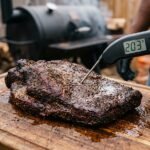
Pull at the right temp. For flats, you’re looking for an internal temperature between 200–205°F, but temperature alone isn’t enough. The probe should slide into the thickest part of the meat like it’s going through warm butter. If there’s resistance, it’s not done yet — regardless of what the thermometer says. Knowing the ideal brisket internal temp and how to test for doneness will save your cook.
Rest it properly. Wrap the flat in butcher paper, then in a towel, and place it in a cooler (no ice) for at least 1 hour. Two hours is even better. Resting lets the juices redistribute throughout the meat instead of pouring out the moment you slice.
And when it’s time to carve, always slice against the grain. On a flat, the grain runs pretty consistently in one direction, so this is straightforward. Pencil-thick slices are the goal.
How to Cook a Packer Brisket
A packer brisket follows many of the same principles, but the scale and complexity go up.
Trimming is essential. With a packer, you’ll need to trim the fat cap, remove any hard chunks of fat (especially the large crescent-shaped piece between the flat and point), and clean up the edges. This isn’t optional — untrimmed hard fat won’t render during cooking and just creates an unpleasant eating experience.
Seasoning stays simple. Same dalmatian rub works here. Some cooks add garlic powder or onion powder, and that’s fine. Just don’t overpower the beef.
Temperature management is key. At 225°F, a full packer can take 14–18 hours. That’s a long time to babysit a smoker. Many experienced cooks run their smoker at 250°F or even 275°F to shave off a few hours without sacrificing quality. Finding the best temperature to smoke brisket depends on your equipment, your schedule, and your personal preference.
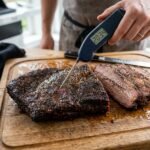
Probe placement matters. With a packer, you have two different muscles at two different thicknesses. Always place your temperature probe in the thickest part of the flat — it’s the part that takes longest to cook and the part most likely to dry out. Learn exactly where to probe your brisket so you’re reading the right spot.
The stall hits harder. A bigger piece of meat means more moisture to evaporate, which means the stall can last longer. Wrapping at 160–170°F internal temp helps. Some pitmasters use the Texas Crutch (foil wrap), while others prefer butcher paper. Both work.
Rest time is non-negotiable. A packer needs at least 1–2 hours of rest, and many competition cooks rest their briskets for 4–6 hours in a holding oven or cooler. The longer rest further tenderizes the meat and evens out the temperature.
After resting, separate the point from the flat along that fat seam. Slice the flat against the grain, and either slice or cube the point for burnt ends. Knowing how to reheat brisket properly is also worth learning, because with a full packer, you’ll almost certainly have leftovers.
The Point: The Part People Forget About
Since we’re comparing the flat to the packer, it’s worth spending a moment on the point — because that’s the piece you gain when you buy a packer instead of just a flat.
The point is smaller (usually 4–7 pounds), thicker, and loaded with intramuscular fat. It doesn’t slice as neatly as the flat, which is why it’s often cubed and turned into burnt ends — those caramelized, saucy, candy-like bites of brisket that people literally fight over at BBQ competitions.
If you’ve never had properly made burnt ends, you’re missing out on one of the best things that can come off a smoker. And you can only make them if you buy a packer.
The point is also more forgiving than the flat. Its higher fat content means it stays moist and tender even if your cook runs a bit long. For this reason, some pitmasters actually prefer to buy just the point (sometimes labeled “brisket deckle” or “second cut”) — though it’s harder to find at regular grocery stores.
When Should You Buy a Flat?
A flat makes sense in specific situations. You don’t always need the whole animal, and there’s no shame in choosing the cut that fits your day.
Go with a flat when you’re cooking for 4–6 people and don’t want a week’s worth of leftovers sitting in your fridge. It also makes sense when your smoker is on the smaller side — some bullet smokers and smaller pellet grills simply can’t fit a full 15-pound packer. A flat will fit comfortably and still deliver great results.
Flats also work well for weeknight or short-day cooks. If you can’t commit to a 14-hour smoke, a flat gives you that brisket experience in roughly half the time.
And if you’re making dishes where presentation matters — like sliced brisket for a holiday dinner or brisket sandwiches for a party — the flat gives you cleaner, more photogenic slices.
When Should You Buy a Packer?
A packer is the move when you’re cooking for a crowd of 10+, when you want both sliced brisket and burnt ends, or when you’re trying to develop your smoking skills on a more forgiving cut.
It’s also the better financial choice for larger gatherings. That lower per-pound cost stacks up when you’re buying 15+ pounds of meat. And the leftovers from a packer freeze beautifully for months — just portion them into vacuum-sealed bags and you’ve got ready-made meals whenever you want.
Competition BBQ teams almost exclusively use packers. Not just because of the extra meat, but because judges evaluate both the flat and the point, and the interplay between the two muscles during a long cook creates flavors and textures you simply can’t replicate with a flat alone.
If you’re serious about getting better at smoking meat, cooking full packers regularly is one of the best ways to level up. Every cook teaches you something about trimming, fire management, and patience.
Quick Comparison: Flat vs Packer at a Glance
| Brisket Flat | Packer Brisket | |
|---|---|---|
| Weight | 5–10 lbs | 12–20 lbs |
| Fat Content | Low to moderate | High |
| Cook Time (225°F) | 7–10 hours | 14–18 hours |
| Price Per Pound | $6–9 | $3–5 |
| Difficulty | Moderate (less forgiving) | Moderate (more forgiving) |
| Best For | Small groups, clean slices | Large groups, burnt ends + slices |
| Availability | Most grocery stores | Butcher shops, warehouse stores |
Can You Get Both From One Packer?
Yes — and that’s honestly one of the biggest advantages of buying a packer. After the cook, once you separate the point from the flat, you’ve got two completely different eating experiences from one piece of meat.
Slice the flat thin against the grain for traditional brisket plates. Cube the point, toss it in sauce, and throw the cubes back on the smoker for another 1–2 hours for burnt ends. You’ve now got a spread that’ll impress anyone.
Some cooks even separate the flat and point before cooking, which lets them pull each muscle at its ideal doneness. The flat finishes faster, and the fattier point can handle extra time on the smoker. It’s more work, but it gives you maximum control.
FAQ
Is brisket flat the same as a packer brisket?
No. The flat is only one part of a full packer brisket. A packer includes both the flat and the point muscles, connected by a fat seam. When you buy a flat, you’re getting roughly half the meat and missing the fattier, more flavorful point section entirely.
Which is more tender — brisket flat or packer?
A properly cooked packer tends to be more tender overall because the point muscle’s extra fat keeps things moist during the long cook. The flat can absolutely be tender too, but it requires more precise temperature control and careful timing. If you overcook a flat, it dries out faster than a packer would.
Can I smoke a brisket flat like a packer?
You can smoke a flat using the same method — low and slow, with a good rub, and wrapping during the stall. But you’ll need to adjust your expectations on cook time (shorter), moisture management (more critical), and the final product (clean slices but no burnt ends). The technique is similar, but the margin for error is tighter with a flat.
How much brisket flat do I need per person?
Plan for about ½ pound of cooked brisket per person. Since a flat loses roughly 40% of its raw weight during cooking (from fat rendering and moisture loss), start with about ¾ to 1 pound of raw flat per guest.
Where should I buy a packer brisket?
Warehouse stores like Costco and Sam’s Club are great sources for USDA Choice and Prime packers at reasonable prices. Local butcher shops often carry them too, and some online meat suppliers like Snake River Farms or Porter Road will ship packers directly to your door. Regular grocery stores mostly stock flats.
The Final Word
Choosing between a brisket flat and a packer really comes down to three things: how many people you’re feeding, how much time you have, and what kind of eating experience you want.
The flat gives you convenience, cleaner slices, and a shorter cook. The packer gives you versatility, better value for large groups, and that incredible fatty point that makes BBQ lovers weak in the knees.
If you’re just starting your brisket journey, try both at different times. Cook a flat on a Saturday when time is tight. Then block off an entire weekend, wake up at 4 AM, and smoke a full packer. You’ll learn something different from each cook — and honestly, you’ll probably end up loving both for different reasons.
Either way, respect the meat, manage your fire, and give it the rest it deserves. The brisket will take care of the rest.