You’ve spent 12 hours nursing a brisket on the smoker. The bark looks beautiful. The smell is driving your neighbors crazy. You slide your thermometer probe in, it reads 203°F, and you pull it off the smoker with confidence. But when you slice into it? The flat is dry as cardboard, while the point is still chewy and undercooked.
What went wrong? You probed in the wrong spot.
Knowing where to probe brisket is honestly one of the most overlooked skills in BBQ. Most people obsess over rubs, wood types, and wrapping techniques, but if your thermometer isn’t reading from the right location, none of that matters. You’re flying blind with a false sense of control.
A brisket isn’t like a chicken breast or a pork chop — it’s two completely different muscles joined together, each cooking at its own pace. Sticking your probe in a random spot and trusting that number is like checking the weather in Dallas and assuming it’s the same in Houston. Same state, totally different story.
Let’s break down exactly where your probe should go, why that spot matters, and how to adjust your approach based on whether you’re cooking a full packer, a flat, or just the point.
Understanding Brisket Anatomy (It’s Two Muscles, Not One)
Before you even pick up a thermometer, you need to understand what you’re actually cooking. A full packer brisket has two distinct muscles separated by a thick layer of fat called the fat cap or the deckle.
The flat is the leaner, thinner section that sits on the bottom. It’s the part most people picture when they think of sliced brisket — those neat, uniform slices with a smoke ring. Because it’s lean, the flat is more prone to drying out if overcooked even slightly.
The point sits on top of the flat, toward the thicker end of the brisket. It’s fattier, more marbled, and much more forgiving. This is the section that gets chopped up for burnt ends or those thick, juicy chunks people fight over at the table.
Here’s the thing that trips people up: because the point has more intramuscular fat, it cooks differently than the flat. The fat renders at its own pace, insulating the meat and changing how heat moves through it. So when you probe the point and get a reading of 200°F, the flat might already be at 208°F and drying out. Or the opposite — the flat could still be at 185°F and sitting in the stall.
This is exactly why probe placement isn’t just a detail. It’s the whole ball game.
The Exact Spot: Where To Probe Brisket
Okay, so here’s the golden rule that pitmasters across Texas, Kansas City, and everywhere in between agree on: probe the thickest part of the flat.
Not the point. Not the seam between the two muscles. Not near the edges. The thickest part of the flat.
Why the flat and not the point? Because the flat is the drama queen of the brisket. It’s thinner, leaner, and the first section to dry out if you push the temperature too far. The point, with all its fat, can handle a few extra degrees without punishment. But if the flat overcooks? There’s no saving it. No amount of sauce or resting will bring moisture back to a dried-out flat.
By monitoring the flat’s temperature, you’re essentially tracking the most vulnerable part of your cook. When the flat hits the right internal temperature — typically between 195°F and 205°F — the point will be in great shape too.
To find the exact spot, place your brisket in front of you with the point (the thicker, fatter end) facing away. Now look at the flat — the thinner, flatter section closer to you. Find the area where the flat is at its thickest, usually a few inches in from the edge. That’s your target.
Pro Tip: If you’re not sure where the thickest part is, gently press down along the flat with your hand before the cook starts. You’ll feel where the meat has the most mass. Mark that spot mentally — or even with a small toothpick — so you know exactly where to probe later.
How Deep Should the Probe Go?
Getting the right spot is only half the equation. Depth matters just as much.
You want the tip of your thermometer probe to sit right in the center of the meat’s thickness at that spot. If the flat is 2.5 inches thick at your chosen point, the probe tip should be about 1.25 inches deep.
Too shallow, and you’re reading the temperature of meat that’s closer to the heat source — it’ll read higher than the actual center. Too deep, and you might push through the flat entirely and hit the fat layer underneath, or even the cooking grate. Fat doesn’t conduct heat the same way muscle does, so you’ll get a misleading reading that could be either higher or lower than reality.
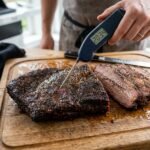
The angle matters too. Don’t stab straight down through the top like you’re planting a flag. Instead, insert the probe horizontally from the side of the flat, parallel to the cooking grate. This approach keeps the entire sensing tip within the same plane of meat, giving you a much more accurate and consistent reading.
Think about it this way — if you go in from the top on a 2-inch thick flat, you’ve only got about an inch of meat above and below the tip. Any slight miscalculation, and you’re reading the temperature of the bark on top or the fat below. But if you insert from the side, horizontally, the probe travels through several inches of pure meat. Even if you’re off by half an inch in depth, you’re still reading meat temperature. It’s a much more forgiving technique.
Should You Use a Leave-In Probe or an Instant-Read?
This is a question that comes up constantly, and the honest answer is: use both if you can.
A leave-in probe thermometer (like a ThermoWorks Signals, FireBoard, or even a basic dual-probe unit) stays inserted in the brisket throughout the entire cook. It gives you continuous temperature monitoring, so you can track the stall, watch the climb, and know exactly when you’re approaching your target. Most modern leave-in thermometers connect to your phone via Bluetooth or WiFi, which means you don’t have to keep opening the smoker lid — and every time you open that lid, you’re losing heat and adding time to the cook.
An instant-read thermometer (the ThermoWorks Thermapen is the gold standard here) is what you use for spot-checking. When your leave-in probe says you’re at 195°F, you grab your instant-read and poke the brisket in 4 or 5 different spots to confirm. This gives you the full picture — is the whole flat done, or just the spot where your leave-in probe happens to be?
Here’s a real scenario that happens all the time: your leave-in probe reads 203°F, so you think you’re done. But when you check with an instant-read, the thinnest edge of the flat reads 210°F (overcooked) and a thicker section near the point reads only 190°F (not ready yet). Without that spot-check, you’d have pulled the brisket thinking everything was perfect.
If you need a refresher on reading thermometer types correctly, this guide on how to read a meat thermometer covers the basics really well.
Where To Probe Brisket During the Stall
Ah, the stall. That maddening period — usually between 150°F and 170°F — where your brisket’s internal temperature just… stops climbing. Sometimes for hours. It’s enough to make you question your entire setup.
During the stall, evaporative cooling is doing its thing. Moisture from inside the meat is reaching the surface and evaporating, which cools the brisket down at the same rate the smoker is trying to heat it up. It’s basically the brisket sweating. And just like sweating cools your body, it cools the meat.
Your probe placement doesn’t change during the stall, but what you do with the information matters. If you’re seeing the stall drag on and you decide to wrap — using butcher paper or foil — the timing of that wrap depends on accurate temperature readings from the right location.
Most experienced pitmasters wrap between 165°F and 170°F internal temp, and that number needs to come from the thickest part of the flat, exactly where we discussed. If your probe is in the point (which might hit 170°F faster because of its shape and fat content), you could end up wrapping too early for the flat, which is still sitting at 155°F and needs more time with direct smoke exposure to build bark.
Quick Fact: The stall can last anywhere from 2 to 6 hours depending on the size of your brisket, your smoker temperature, and humidity levels. Don’t panic. Trust the process, and trust your probe placement.
Probing the Point vs. Probing the Flat: When and Why
I’ve been pretty clear that the flat is your primary monitoring spot. But there are times when you absolutely should check the point too.
If you’re planning to separate the flat and point after cooking — say you want sliced brisket from the flat and burnt ends from the point — then knowing the point’s internal temperature gives you the flexibility to pull one section off the smoker while letting the other continue.
If you’re cooking just a point (some butchers sell them separately, and they’re fantastic for chopped brisket), then the point becomes your primary probe location. Same rules apply: thickest part, center of the meat, horizontal insertion.
If you’re cooking just a flat (which is more common at grocery stores — they often sell flats as “brisket”), then you’re only dealing with one muscle. Probe the thickest section, and you’re set. Flats cook faster than full packers because there’s less mass, so keep a closer eye on temperature. A flat can go from perfect to dry in 20-30 minutes if you’re not paying attention. Understanding when to pull brisket off the smoker is everything here.
The “Probe Tender” Test: Temperature Isn’t Everything
Here’s something that separates good brisket from truly great brisket: the probe tender test. Also called the “butter test,” this is what happens when you slide your thermometer probe into the brisket and it goes in with almost no resistance — like pushing into warm butter or a ripe avocado.
Temperature gives you a number. Probe tenderness gives you a feeling. And in brisket, feeling matters more.
Two briskets can both read 203°F internally, but one might be probe tender while the other still has resistance. Why? Because connective tissue (collagen) breaks down at its own pace based on factors beyond just temperature — time at temperature, moisture content, how much collagen was in the meat to begin with, and even the age of the animal.
When you do the probe tender test, check multiple spots across the flat. The probe should slide in and out smoothly everywhere, not just in one sweet spot. If the center of the flat is probe tender but the edges still have resistance, give it more time. If the thin end of the flat feels mushy and offers zero resistance, it might be slightly overcooked there — but that’s often unavoidable with larger briskets, and it’s still better than pulling too early.
Some pitmasters target 210°F as their ideal internal temp, while others pull at 195°F if the probe slides in easily. Don’t be a slave to numbers. Use temperature as a guide and tenderness as your final decision-maker.
Smoking Temperature and Its Effect on Probe Accuracy
You might not think about this, but the temperature you’re smoking your brisket at directly affects how you interpret your probe readings.
At 225°F (the low-and-slow classic), heat penetrates the brisket very gradually. The temperature gradient from the surface to the center is relatively gentle, meaning your probe reading in the center is a pretty reliable indicator of the overall flat’s doneness. There are fewer “hot spots” and “cold spots” throughout the meat. If you’re a fan of this approach, this article on smoking brisket at 225 goes into the details.
At 275°F or higher (the hot-and-fast approach), the outside of the brisket heats up much faster than the inside. This creates a steeper temperature gradient — the outer inch of meat might be 20-30 degrees hotter than the center. In this situation, your probe reading in the center might show 190°F while the outer portions of the flat are already well past 200°F. This is why hot-and-fast cooks require more frequent spot-checking with an instant-read.
The key takeaway? The lower your smoker temperature, the more you can trust a single probe reading. The higher your smoker temperature, the more you need to check multiple spots.
Common Probe Placement Mistakes
Let me walk you through the mistakes I see people make over and over again — and I’ve made most of these myself at some point.
Probing through the fat cap. If your brisket is sitting fat-side up and you push the probe straight down through the fat, you’re traveling through a layer of insulating fat before reaching meat. That fat affects the reading. Always insert through exposed meat, not through the fat cap.
Probing the seam between the flat and point. That junction where the two muscles meet has a thick layer of intermuscular fat. If your probe tip is sitting in that fat seam, you’re not reading meat temperature at all. You’re reading fat temperature, and fat behaves completely differently than muscle when it comes to heat absorption.
Probing too close to the edge. The edges of the flat are thinner and closer to the heat source. They’ll always read higher than the center. If you probe an inch from the edge and see 205°F, the center might only be at 185°F. Always go for the thickest part, well away from the edges.
Not accounting for bone-in or trimming. If you’ve trimmed your brisket aggressively (or if you’re working with a brisket that has unusual proportions), the “thickest part” might be in a different spot than you’d expect. Take a moment to actually look at and feel your brisket before deciding where to probe.
Moving the probe repeatedly. Every time you pull the probe out and re-insert it, you create a new hole. Those holes let moisture escape during the cook. If you’re using a leave-in probe, set it once and leave it alone. Use your instant-read for additional checks.
Full Packer vs. Flat Only: Does Probe Placement Change?
If you’re cooking a full packer brisket (both flat and point together, usually 12-18 pounds), everything I’ve described so far applies exactly as stated. Probe the thickest part of the flat, horizontal insertion, center of the meat.
With a flat-only brisket (typically 5-8 pounds), the same principles hold, but you need to be more vigilant. Flats by themselves cook faster and are more susceptible to drying out because there’s no fatty point sitting on top to baste and protect them. Some people wrap flat-only briskets earlier, and some decide whether to brine the brisket beforehand to add moisture insurance.
If you’re choosing between a flat and a full packer, keep in mind that a full packer is more forgiving with probe placement because there’s simply more mass. A flat-only brisket has a narrower window between “not done” and “too done,” so accurate probe placement becomes even more critical.
After the Cook: Probing During the Rest
You pulled the brisket. Congratulations. But your thermometer work isn’t done yet.
During the rest (and you absolutely should rest a brisket — ideally for at least one hour, though many competition teams rest for 2-4 hours in a cooler), carryover cooking will push the internal temperature up another 5-10 degrees. If you pulled at 203°F, it might peak at 208-210°F during the rest before slowly declining.
If you have a leave-in probe, keep it in during the rest. You want to make sure the internal temperature stays above 140°F for food safety. If the brisket drops below that — which can happen if you rest for too long without insulation — you need to either serve it or get it into a low oven (around 170°F) to keep it in the safe zone.
Knowing the right resting protocol makes a big difference in the final product. And when it’s time to slice your brisket, the internal temp should ideally be between 140°F and 160°F — warm enough to serve but cool enough that it holds together when you cut against the grain.
FAQ
Can I probe brisket from the top?
You can, but it’s not the most accurate method. Inserting from the top means the probe travels through the bark and potentially through fat before reaching the meat center. You also risk the tip ending up in the fat layer between the flat and point. Horizontal insertion from the side of the flat gives you a much more reliable reading because the entire probe tip stays within the muscle.
What temperature should brisket read when it’s done?
Most pitmasters pull brisket between 195°F and 205°F, but the real indicator is probe tenderness. Your thermometer should slide into the flat like a hot knife through butter. Some briskets are perfect at 197°F, while others need to hit 207°F before the collagen fully breaks down. Don’t fixate on a single magic number.
How many times should I check brisket temperature during a cook?
If you’re using a leave-in probe, you’re getting continuous readings and don’t need to open the smoker to check. Once the brisket enters the 190°F range, start spot-checking with an instant-read every 30 minutes or so in 3-4 different locations across the flat. Before that point, you’re just adding cook time every time you lift the lid.
Does it matter if I probe through the fat side?
Yes, it does. Fat reads temperature differently than muscle tissue. If your probe tip is sitting in fat — either the fat cap or the intermuscular fat seam — you won’t get an accurate reading of the meat’s doneness. Always make sure the probe tip is fully embedded in lean meat.
Should I use two probes for a full packer?
If your thermometer system supports it, absolutely. Place one probe in the thickest part of the flat (your primary monitoring spot) and a second probe in the thickest part of the point. This gives you the complete picture and helps you decide whether to separate the two muscles at different times or pull the whole brisket at once.
Your Probe Tells the Story — Make Sure It’s Reading the Right Chapter
Getting brisket right takes patience, practice, and paying attention to the details that most people skip. Probe placement is one of those details. It’s not glamorous. Nobody’s posting Instagram stories about where they stuck their thermometer. But it’s the difference between brisket that melts in your mouth and brisket that makes people quietly reach for the sauce bottle.
Next time you fire up the smoker, take 30 extra seconds to find the thickest part of the flat, insert your probe horizontally through the side, and make sure the tip is dead center in the meat. That tiny effort pays off in a massive way.
And if you’re still building your brisket skills — figuring out how much brisket to buy per person, or debating prime vs. choice grade — know that every cook teaches you something new. The best pitmasters aren’t the ones who never made mistakes. They’re the ones who figured out where those mistakes were hiding.
Your thermometer can only tell you the truth if you put it in the right place. So put it in the right place.